Let’s dive into casino math. That spinning wheel is more than just pretty. It’s a well-designed way to make money.
American roulette has 38 pockets, while European has 37. That extra double zero is key. It’s where the casino makes its profit.
The house edge goes from 2.7% to 5.26% with that extra pocket. It’s like a service fee for playing.
We’ll explore why payouts don’t match true roulette odds. It’s not just luck. It’s probability in disguise.
Your bankroll plays a big role in this game. It’s both the judge and the player in the dance of chance and stats.
Payout Tables and Bet Types
Ever notice how casino payouts feel like ordering a luxury car only to discover they charged you for the premium sound system but gave you basic speakers? That’s the elegant mathematics of roulette payouts in action. The house offers you 35:1 on single numbers when the true odds are actually 37:1 in American roulette. It’s capitalism’s most charming magic trick.
Let’s break down the betting menu. You’ve got two main categories: inside bets (the high-risk thrill seekers) and outside bets (the conservative investors). Inside bets cover specific numbers or small groups, while outside bets play the larger probability game.
The payout calculation is simpler than your last relationship drama: divide 36 by the number of squares covered, then subtract 1. Bet on a single number? 36/1 – 1 = 35:1. Bet on red/black covering 18 numbers? 36/18 – 1 = 1:1. The casino always keeps that one extra unit – their version of a service charge.
Here’s how the payout rates break down across different bet types:
| Bet Type | Numbers Covered | Payout | True Odds |
|---|---|---|---|
| Straight Up | 1 | 35:1 | 37:1 |
| Split | 2 | 17:1 | 18:1 |
| Street | 3 | 11:1 | 11.33:1 |
| Corner | 4 | 8:1 | 8.5:1 |
| Six Line | 6 | 5:1 | 5.17:1 |
| Outside Bets | 18 | 1:1 | 1.06:1 |
Notice how every payout rate is just slightly less than the true odds? That’s not coincidence – that’s business. The difference is how casinos pay for those fancy chandeliers and free drinks.
Outside bets might feel safer with their nearly 50/50 odds, but they’re the equivalent of putting all your retirement funds in government bonds. Steady, predictable, and ultimately designed to slowly separate you from your money through countless small losses.
Inside bets offer the tantalizing possibility of big wins, but they’re the lottery tickets of the roulette world. The thrill comes with astronomical odds against you – the mathematical equivalent of hoping your ex texts you back after you sent that 3 AM message.
Understanding these payout rates isn’t just about memorizing numbers. It’s about recognizing the house’s built-in advantage in every possible scenario. Whether you’re betting red or black, odd or even, or putting it all on your birthday number, the payout structure ensures the house always wins in the long run.
Next time you’re at the table, remember: those payout rates aren’t just numbers. They’re the carefully calculated price tags on hope itself.
Comparing House Edges
Choosing between American and European roulette is like picking between a mortgage with 5.26% interest versus one at 2.7% – the difference compounds faster than political scandals. That extra double-zero pocket might seem trivial until you realize it’s mathematically equivalent to paying a 5.26% service charge on every transaction versus 2.7%.
The house edge represents the casino’s built-in mathematical advantage, and it’s where the real money gets made over time. American roulette’s 5.26% edge means you’ll theoretically lose $5.26 for every $100 wagered long-term. European wheels cut that nearly in half to 2.7% – a difference that becomes as noticeable as the gap between coach and first class after several hundred spins.
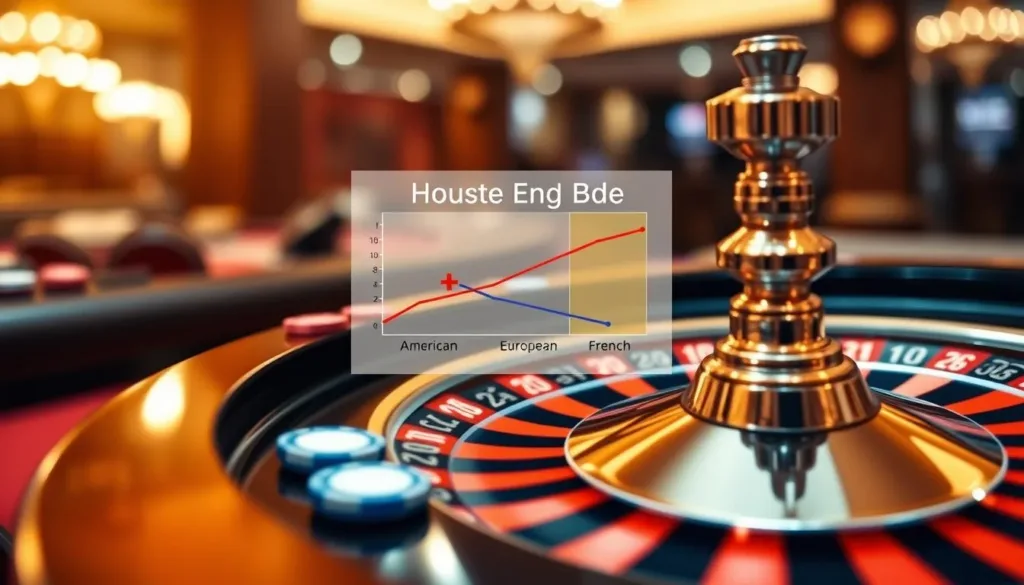
Let’s break down the numbers in a way that would make your financial advisor proud:
| Roulette Type | House Edge | Key Feature | Theoretical $100 Loss |
|---|---|---|---|
| American | 5.26% | Double zero (0, 00) | $5.26 |
| European | 2.7% | Single zero (0) | $2.70 |
| French (La Partage) | 1.35% | Half back on even-money zero | $1.35 |
French roulette takes player-friendliness to Monte Carlo levels with its La Partage rule. When zero hits on even-money bets, you get half your wager back – effectively halving the house edge to 1.35%. It’s the financial equivalent of finding a tax loophole that actually benefits the little guy.
The probability mathematics behind these differences isn’t rocket science, but it’s consistently overlooked by players mesmerized by spinning wheels. That 2.56% gap between American and European roulette represents the cost of that additional double-zero pocket – a premium that adds up faster than campaign promises during election season.
Over 1,000 spins, that difference could mean hundreds of dollars staying in your bankroll. This is instead of funding the casino’s new fountain display. It’s the kind of financial efficiency that would make Warren Buffett nod approvingly while simultaneously explaining why he doesn’t gamble.
Understanding these probability differences transforms roulette from pure chance to calculated risk management. The house always wins in the long run, but you get to choose whether they win at luxury hotel rates or budget motel prices.
Probability of Hitting Numbers/Colors
Let’s get real with some math. The roulette odds are more than just numbers. They’re where hope meets reality.
Want to hit a specific number? The odds are 2.63% in American roulette and 2.70% in European. It’s like guessing someone’s birthday month on the first try. It’s not impossible, but not worth risking everything.
Red or black bets are a real brain-twister. Most think it’s like flipping a coin, but the zeros help the casino. American tables give you 46.37% chance, while European offers 48.65%. It’s not 50/50; it’s more like 48/52, with the house always ahead.
Probability gets really interesting here. The law of large numbers makes these percentages true over thousands of spins. But in the short term, our minds play tricks on us.
Seeing seven reds in a row doesn’t mean black is next. Each spin is independent. Yet, we think streaks must end. It’s like buying lottery tickets after a big win.
The math doesn’t lie. While you might win short-term, the roulette odds favor the house long-term. It’s math versus wishful thinking, and math wins.
Knowing these odds changes how you play. You see the game as math, not just fun.
Next time you want to bet after five blacks, remember the roulette odds. The wheel doesn’t care about your streak, and neither does probability.
Statistical vs. Emotional Decisions
Watching roulette players is like watching a live show of behavioral economics. The actors use real money, and the script is written by cognitive biases. The green felt stage shows the battle between probability and emotion in a fun way.
Understanding roulette means knowing each spin is independent. The wheel doesn’t remember, feel, or owe anyone anything. Yet, I’ve seen more people talking to roulette wheels than to their therapists.

- The gambler’s fallacy – Thinking that after five reds, black is “due.” It’s like expecting a coin to remember its last ten flips
- The illusion of control – Believing that complex betting patterns or lucky charms influence outcomes. I’ve seen people blow on dice in craps, but roulette players have their own rituals
- Confirmation bias – Remembering when you hit your number but forgetting the twenty times you didn’t. It’s like watching only the highlight reel
Mathematical models show the house edge stays the same, no matter the betting system. No pattern recognition changes the probability structure. The wheel doesn’t care about your winning or losing streak.
Emotional decisions often lead to chasing losses. Doubling down after losses because “it has to turn around.” This is like digging deeper when you’re already in a hole.
Bankroll management is the statistical approach. It’s about calculating risk, understanding expected value, and seeing roulette as entertainment with mathematical certainty.
The most dangerous phrase in any casino isn’t “place your bets” – it’s “I feel lucky today.” This emotional trigger can make rational adults ignore the odds.
Smart players know they can’t beat the odds but can avoid being beaten by them. They accept the mathematics and enjoy the game without expecting fairness from the wheel.
Real Examples
Let’s look at real-life betting scenarios. These aren’t just theories but actual bets that show how probability works with real money. It’s like a financial autopsy of gambling strategies.
Our first player bets $10 on black and $1 on 10 red numbers. It seems smart to cover many bases, right? Let’s see how it works out.
The European wheel has 37 numbers. Black and red each have 18 spots, and green has 1. This complex bet actually increases the house edge, not decreases it.
Here’s the math: if black hits, they win $10 but lose $10 on red. Net result: zero. If a red number hits, they win $35 but lose $10 on color. Net: $25. If green hits, they lose everything.
| Bet Type | Amount | Probability | Net Outcome |
|---|---|---|---|
| Black Color Bet | $10 | 48.6% | $0 |
| Red Number Hits | $1 x 10 | 27.0% | $25 |
| Green Hits | N/A | 2.7% | -$20 |
| Other Outcomes | N/A | 21.7% | -$20 |
This strategy has four outcomes with negative expected value. The math shows an expected loss of $2.70 per spin. It’s worse than just betting on black alone!
Now, let’s look at the Martingale system. It’s like thinking you can beat traffic by driving faster. Players double bets after losses, hoping to win back money.
It works until it doesn’t. Like before the 2008 crash, Martingale creates a false sense of control. A $5 bet can turn into a $160 wager to break even after five losses.
Table limits and limited bankrolls make Martingale unsustainable. It doesn’t change the probability – it just changes how you lose money.
These examples of probability show why no system can beat the house edge long-term. It’s not about winning but making smart decisions on risk and reward.
Your bankroll is not a fortune to win but a resource to manage. The real win is understanding the odds well enough to play smart within your means.
Using Odds to Inform Strategy
Roulette strategy is all about knowing the odds. It’s like understanding how to make coffee without burning your tongue. The math is clear, but it won’t play the game for you.
Start by choosing European roulette over American. The extra green pocket on the American wheel costs you 2.56% more. It’s like paying extra for something you don’t need.
Most players get caught up in the excitement of big wins. The 35:1 payout for single numbers is tempting. But, smart players go for outside bets like red/black or odd/even. These bets offer almost even chances, minus the house edge.
Let’s face it: no system beats roulette mathematically. The martingale strategy is just doubling down on losses. The house edge doesn’t change, no matter how much you want it to.
Your real strategies are:
- Set concrete loss limits before you hear that wheel spin
- Understand that short-term wins are variance, not skill
- Never chase losses thinking the odds will “balance out”
- Walk away while you’re smiling
The smart player sees roulette as a game of numbers and psychology. It’s not about beating the system. It’s about enjoying the game while keeping your wallet safe.
Remember, the best bet is knowing when to stop. Walking away with a smile is where the real odds are in your favor.
Conclusion
So, what did we learn about roulette odds? The game isn’t just luck—it’s all about math. The house always wins, and European wheels give you a tiny edge. But no betting system can beat the casino’s built-in advantage.
Learning about roulette odds isn’t about winning against the casino. It’s about understanding the game’s beauty and making smart choices with your money. It’s like playing poker well, not just hoping for luck.
Roulette shows us how life works. Outcomes mix chance and probability. The house always takes its share, like taxes or inflation. The smartest players know the rules before they bet.
Whether you play for fun or serious, remember this: knowing the odds won’t change them. But it might change how you play. And that’s the real win.