Walking onto a casino floor can feel like stepping into a world of pure chance. The lights, the sounds, and the rapid play can make it seem like mathematics has no place here.
That impression is a costly illusion. Every game is built on a precise mathematical framework. Knowing this framework is what separates a casual visitor from a savvy one.
This knowledge revolves around three core ideas: the House Edge, RTP (Return to Player), and Variance. Think of them as the essential vocabulary for any player who wants to make informed decisions.
The House Edge is the casino’s built-in mathematical advantage on every bet. RTP is simply the flip side of that edge—the percentage of wagered money a game is programmed to pay back over time. Variance describes the game’s volatility, or how wildly your results can swing from that theoretical average.
Grasping these concepts transforms the experience. It moves you from hoping for luck to applying analytical thinking. You learn to select games smarter, manage your bankroll better, and set realistic expectations for your session.
House edge vs RTP and what they mean session-to-session
Every bet is like a pie, with the casino and you each getting a slice. This division is based on Return to Player (RTP) and House Edge. Knowing how they work together is key to understanding the game’s math.
Return to Player (RTP) is the percentage of money a game pays back to players over millions of plays. For example, a slot with a 96% RTP returns $96 for every $100 bet. The casino keeps the remaining 4% as profit.
The 4% is the House Edge. It’s the opposite of RTP. The formula to connect them is:
House Edge = 100% – RTP
So, a game with a 96% RTP has a 4% house edge. A game with a 98% RTP has a 2% edge. This rule applies to all casino games.
Different games have different RTP and house edge values. The table below shows how these values vary across popular casino games.
| Game | Typical RTP | Typical House Edge |
|---|---|---|
| Blackjack (with basic strategy) | 99.5% | 0.5% |
| Baccarat (Banker bet) | 98.94% | 1.06% |
| Craps (Pass Line bet) | 98.64% | 1.36% |
| European Roulette | 97.3% | 2.7% |
| American Roulette | 94.74% | 5.26% |
Many players think a 96% return to player means they’ll get $96 back from a $100 session. This is not how it works.
RTP and house edge are long-term statistical averages. They show what happens over millions of bets. Your session is just a small, random part of this.
Choosing a 96% RTP slot means the average return is $96 per $100 wagered over many players. Your $100 could be gone in 10 spins, or you could win big. The math ensures the casino’s 4% edge slowly adds up over all play.
Session-to-session, luck and randomness are in charge. The house edge is like a gentle pull, not a tax per hand. It means the more you play, the closer your results will get to the predicted average, which favors the casino. This sets realistic expectations: you’re paying for fun, knowing the house will win its share over time.
Variance/volatility: why short-term swings happen
Variance is key to understanding the difference between a game’s theoretical payback and your immediate results. Think of volatility as the unpredictable journey to your long-term destination. This is why a slot with a 96% RTP can quickly empty your bankroll, even in just twenty minutes.
Variance is measured by standard deviation. A high standard deviation means results vary widely from the average. For players, this means bigger wins and longer losing streaks. A simpler way to think about it is hit frequency. This shows how often you can expect a winning spin or hand.

Games are categorized by their volatility level: Low, Medium, or High. Your choice affects your bankroll and session experience.
- Low Volatility: Wins are frequent but small. Your bankroll lasts longer, making sessions steadier. This style is less stressful but offers smaller jackpots.
- Medium Volatility: A balance between hit frequency and payout size. You’ll see small wins and occasional large payouts, with moderate bankroll swings.
- High Volatility: Wins are rare but can be huge. These games are known for long dry spells that can quickly empty a small bankroll. They need a larger bankroll and a high risk tolerance.
Understanding this spectrum turns confusion into strategy. By matching a game’s volatility to your bankroll size and risk comfort, you make an informed choice. You’re not just playing a game; you’re choosing the ride you want. For more on this, check out our guide on understanding poker variance.
Ranking Popular Games by Edge (Typical Ranges)
Let’s get straight to it. We’ll rank popular casino games by their typical house edge. This ranking helps you enjoy more playtime and reduce the casino’s edge.
The table below shows where common games stand. Keep in mind, these figures assume you’re betting optimally and using the best strategies.
| Game (Optimal Bet) | Typical House Edge | Typical RTP | Key Notes |
|---|---|---|---|
| Blackjack (Basic Strategy) | ~0.5% | ~99.5% | Lowest edge game; requires memorized strategy. |
| Baccarat (Banker Bet) | ~1.06% | ~98.94% | Simple bet with a near-even chance. |
| Craps (Pass/Don’t Pass Line) | ~1.36% | ~98.64% | Low-edge core bets amidst many high-edge options. |
| European Roulette (Single Zero) | ~2.7% | ~97.3% | One zero wheel; standard in Europe. |
| American Roulette (Double Zero) | ~5.26% | ~94.74% | Extra zero nearly doubles the house edge. |
Blackjack is the undisputed champion for low house edge. A sub-1% edge is only possible with perfect basic strategy. This strategy tells you when to hit, stand, double, or split based on your cards and the dealer’s up-card. Not following it can greatly increase the edge.
In Baccarat, always bet on the Banker bet. Its ~1.06% edge is excellent for a simple game. Avoid the tempting Tie bet, which has a massive edge over 14%. The casino collects a small commission on Banker wins, which is already factored into that edge.
Craps offers great and terrible odds side-by-side. Stick to the fundamental Pass Line or Don’t Pass Line bets. Their edge is a very reasonable ~1.36%. The complex side bets in the center of the table are where the house edge climbs dramatically.
The roulette wheel tells a stark story. A European roulette wheel has one zero, giving the house a 2.7% edge on most bets. The American roulette wheel adds a double zero. This single extra pocket boosts the house edge to 5.26% on those same bets. That extra zero is a pure cost to you.
Games like slots and keno typically reside at the higher end of the house edge spectrum. Their exact odds are why understanding payout tables and specific rules, our next topic, is so critical.
Payout Tables and Rules That Change the Math
Choosing games is just the start. Knowing how rules and paytables change the math is key. It sets apart smart players from the rest.
The house edge for games like blackjack or roulette is just a starting point. The real version in casinos can be much more expensive.
Blackjack is a prime example. The payout for a natural blackjack is a big deal. A 3:2 payout is standard, but a 6:5 payout is less favorable.
The difference is huge. A $10 bet on a 3:2 blackjack wins $15. But a 6:5 payout only wins $12. This rule change can more than double the house edge.
Other blackjack rules also matter a lot:
- Surrender: Lets you give up half your bet on a bad hand, saving money.
- Doubling After Split (DAS): Boosts your win on strong hands.
- Dealer Stands on Soft 17 (S17): This rule is better for players than the dealer hitting.
Always check these rules before playing. A table with 6:5 blackjack should be avoided, even with other perks.
Roulette also has rule changes that affect the math. On a standard American double-zero wheel, even-money bets have a 5.26% house edge.
Some tables, called French roulette, offer “En Prison” or “La Partage” rules. If the ball lands on zero on an even-money bet, your bet is either kept for the next spin or you lose half of it.
This rule halves the house edge on those bets, making it around 2.7% on a double-zero wheel. It’s a big win for players.
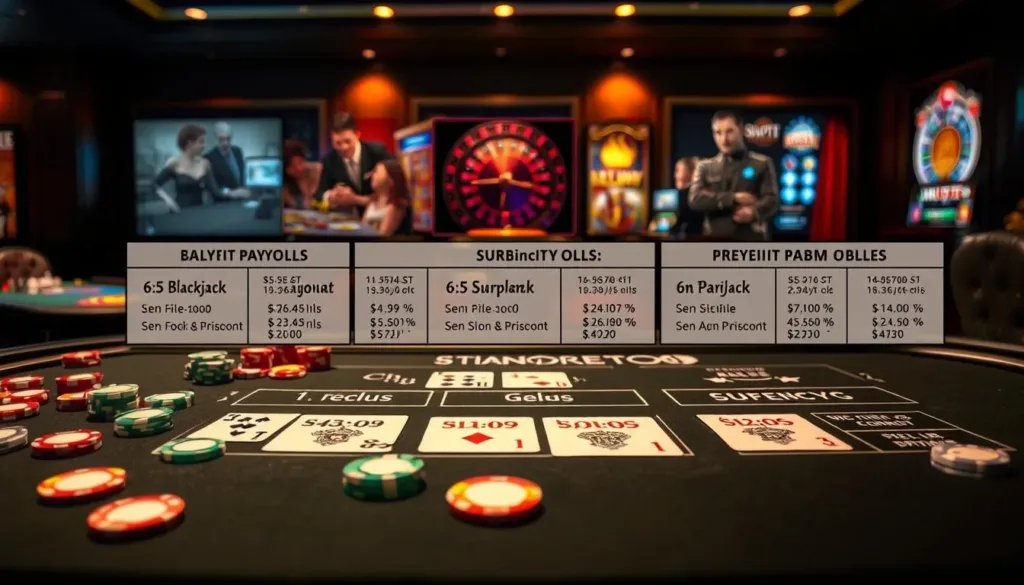
For slot machines and video poker, the paytable is critical. It lists prizes for each combination and affects the game’s RTP.
Hit frequency is important here. Games with high hit frequency give out smaller wins more often. Games with low hit frequency offer less frequent wins but bigger jackpots.
The design of the paytable affects both the game’s volatility and RTP. Experts often advise against side bets, which have a much higher house edge than the main game.
Doing your homework on game selection is essential. Look for the rule set or paytable that offers the best math. For more on these topics, check out the mathematics of games and gambling.
Understanding these details doesn’t guarantee a win. But it ensures you get the most value for your money. Knowing the impact of a 6:5 blackjack table or the hit frequency of a slot helps you make better choices at the casino.
How casinos price entertainment: comps and theoretical loss
Every free drink or discounted hotel room has a precise calculation behind it. Casinos use a pricing model for the entertainment you enjoy. To get the most out of it, you need to understand comps and theoretical loss.
Theoretical loss, or “theo,” is what the casino expects to win from you. It’s based on your bets, how fast you play, and the game’s edge. The formula is simple: Theoretical Loss = Coin-in × House Edge. Your “coin-in” is the total you bet.
Complimentary perks, or comps, are based on this number. Casinos give these rewards as a rebate on your expected loss, not actual wins or losses. They usually return 10% to 40% of your expected loss in free play, meals, rooms, or shows. This is why using your player card for every bet is key—it helps the casino track your worth.
Here’s a key insight for smart players: your game choice affects your theoretical loss. Games with lower house edges mean less loss per dollar. This lets you play longer and get more comps for the same betting level.
| Game (Example) | House Edge | Total Coin-in | Theoretical Loss |
|---|---|---|---|
| Blackjack (Basic Strategy) | ~0.5% | $5,000 | $25 |
| Baccarat (Banker Bet) | ~1.06% | $5,000 | $53 |
| Roulette (Single Zero) | ~2.7% | $5,000 | $135 |
| Slot Machine (Low RTP) | ~7% | $5,000 | $350 |
The table shows a big difference. Betting $5,000 on blackjack results in a $25 loss. But on a high-edge slot, it’s a $350 loss. This means the slot player might get a bigger rebate, but paid more. The blackjack player gets more playtime for less cost.
For the disciplined player, this knowledge is a strategic tool. Choosing games with a higher RTP lowers your theoretical loss. This helps you manage your budget better and earn rewards. Think of comps as a discount on the casino’s entertainment price. Your goal is to minimize this price through smart game selection.
Myths to ditch: “due” machines, hot tables, dealer change
Many casino players hold onto superstitions that harm their bankroll and decision-making. These beliefs, though fun, lead to poor betting and frustration. Letting go of these myths is the first step to a more rational gambling approach.
The key idea that debunks most casino myths is the independence of events. Every spin of a roulette wheel, every card deal, and every slot pull is random and separate. The outcome of one round does not affect the next.
This means a slot machine is never “due” for a jackpot. A hot table does not predict future wins. A dealer change does not reset your luck. These are all illusions from short-term variance, which we discussed earlier.
Let’s tackle the most common false beliefs. The idea of a “due” machine or a “cold” streak ending is called the gambler’s fallacy. It’s the belief that past random events can change future ones. A slot machine’s RNG doesn’t remember past results. It generates new, independent results every millisecond.
Also, the myth of the “hot” table or dealer is just a player seeing a cluster of wins. In games like craps or roulette, a short series of wins is normal over thousands of plays. It’s not a sign that the trend will continue. The house edge stays the same on every bet.
Another myth is that casinos can change a game’s payout percentage while you’re playing. In regulated markets, this is impossible. The RTP (Return to Player) and house edge are fixed in the game’s software or design.
Licensed casinos can’t legally change this math on the fly. Any change needs a physical machine update or a software change, controlled by gaming authorities. The time of day, your betting size, or your “luck” doesn’t change the RTP.
| Common Myth | The Reality | The Math Behind It |
|---|---|---|
| “This machine is due for a hit.” | Each play is an independent event. Past losses do not increase future win probability. | An RNG ensures every outcome is random. Probability resets completely with each spin. |
| “That blackjack table is hot—stay there!” | Winning streaks are random clusters, not predictable patterns or dealer skill. | Variance causes short-term swings. Long-term results always converge to the game’s fixed house edge. |
| “The casino lowered the RTP because I was winning.” | Game math is certified and fixed. Casinos cannot remotely alter payout percentages during play. | RTP is a legal parameter programmed into the game. Changes require physical access and regulatory approval. |
Betting systems like the Martingale (doubling bets after a loss) are often sold as ways to beat myths. They don’t, and can’t, change the house edge. They only change your bet sizing within the same unfavorable odds.
Replacing superstition with knowledge is empowering. When you know results are based on independent events and fixed math, you can focus on what you can control. This includes your budget, game choice, and time at the table. This rational mindset is the true advantage.
Quick checklist: 5 rules to find the friendliest math on any floor
Let’s make theory real with a simple checklist. It helps you spot the best odds fast. You don’t need to be a math expert. Just a basic filter to find smart plays.
Keep these five rules in mind. They guide you to games with the best odds for you.
- Know Your Edge Before You Bet
Always look for the game with the lowest house edge. This is your best filter. For example, choose European Roulette over American Roulette. The edge drops from 5.26% to 2.70%.
For slot machines, check the Return to Player (RTP) percentages. Aim for games with an RTP above 97%. This info is in the game’s help menu.
- Master the Basic Strategy for Skill Games
In games like blackjack and video poker, your skill matters. Learning the optimal strategy is key. Use a basic strategy chart for blackjack. Memorize the right play for every hand.
For video poker, know the paytable and the perfect hold strategy. This turns a high-variance game into one of the best odds on the floor.
- Scan the Rules Before You Sit Down
Look for player-friendly rules. For blackjack, choose 3:2 payouts over 6:5. In roulette, check for “La Partage” or “En Prison” on even-money bets. These rules cut the house edge in half.
Avoid rule traps. Steer clear of automatic side bets and bonus wagers. They almost always have a much higher house edge than the main game.
Don’t play high-variance progressive slots with a small bankroll. High volatility means bigger, less frequent wins. It can quickly wipe out a small bankroll.
If your budget is limited, choose games with lower volatility. Think blackjack, baccarat, or low-variance slots. Your money will last longer, giving you more fun.
- Play the Long Game with Comps and Limits
Always use your player’s card. Comps are a rebate on your theoretical loss. They make the effective house edge smaller over time. Remember, comps are priced into the game’s math.
Most importantly, set firm time and money limits before you play. The friendliest math in the world won’t help if you play past your limits.
To put it all together, here’s a snapshot of how popular games stack up when you apply these rules:
| Game | Typical House Edge | Key Player-Friendly Rule | Volatility Level |
|---|---|---|---|
| Blackjack (Basic Strategy) | 0.5% | 3:2 Payout, Late Surrender | Low to Medium |
| European Roulette | 2.70% | Single Zero Wheel, La Partage | Low |
| Baccarat (Banker Bet) | 1.06% | Low Commission (5% or less) | Low |
| Craps (Pass Line) | 1.41% | 3x-4x-5x Odds Allowed | Medium |
| Video Poker (9/6 Jacks) | 0.46% | Full-Pay Paytable | High |
This checklist is your tool. It simplifies complex casino odds into easy steps. Remember, the goal is to enjoy more while spending less. Walk onto any casino floor with these five rules, and you’ll spot the friendliest math right away.
Play responsibly: time and budget caps
Smart casino play means controlling how much you spend and how long you play. Knowing about house edge and variance is key. But, you also need rules for your time and money.
Begin each play session with a set bankroll. A good rule is to have enough for 300 times your average bet. This helps you handle normal ups and downs. But, it’s more critical to set a loss limit, like 25% of your session bankroll.
When you hit that loss limit, stop playing. This rule removes emotions and keeps your money safe. Also, set a win goal. Decide on a profit amount that tells you it’s time to stop.
Having a win goal helps you avoid losing everything during bad times. Combining a loss limit with a win goal lets you control how long you play. This approach is the best strategy.
It ensures the house edge doesn’t get too much time to work against you. For more tips on mastering basic strategy and bankroll discipline, check out additional resources. Playing responsibly is not a limit. It’s the smart way to enjoy games for a long time.