What makes a seasoned player different from someone who just relies on luck? It’s often a powerful math concept. In sports betting, making smart choices is key for success. This is also true for casino games.
Expected Value (EV) is a vital tool for serious players. It helps you decide if a bet is good. It turns gambling into a skill-based game.
EV isn’t just for math experts. It’s for anyone wanting to bet smarter. Knowing EV is the first step to playing like a pro.
We’ll explain what EV means in simple terms. Then, we’ll dive into the expected value formula and how to use it. For more on probabilities, check out our guide on understanding casino odds. Let’s get started.
What EV measures and why it matters more than “luck”
Imagine a 101-sided die: EV shows why having just one more winning side creates a powerful, lasting advantage that luck cannot overcome. Expected Value is not a prediction for your next bet. It is a long-term average. It answers a simple but profound question: “If I could make this same bet thousands of times, what would my average profit or loss be per wager?”
This mathematical expectation separates smart strategy from blind hope. While a single session can swing wildly due to variance—what we call luck—EV remains constant. It measures the inherent edge built into the rules of the game or a specific betting opportunity.
Let’s return to that 101-sided die. If 50 sides are red and 51 are blue, and you win $1 for blue, your EV is positive. For every $1 bet, you expect to win slightly more than you lose over a massive number of rolls. That tiny mathematical edge is what EV quantifies. It proves that long-term success is defined by consistent, calculable advantages, not random short-term outcomes.
The table below highlights the fundamental shift in thinking that understanding EV requires:
| Aspect | Luck-Based Thinking | EV-Based Thinking |
|---|---|---|
| Focus | Immediate, short-term results | Long-term average outcome |
| Mindset | Superstitious, emotional | Analytical, disciplined |
| Control | Believes in fate or “hot streaks” | Focuses on decisions with a positive edge |
| Outcome | Unpredictable and volatile | Mathematically predictable over time |
This framework empowers you to move beyond superstition. You stop worrying about the unlucky roll you just saw and start evaluating whether the bet you’re about to make has a positive expectation. The goal is to make decisions that are profitable in the aggregate, not to win every single time.
Why does this matter more than luck? Because luck evens out. Variance is temporary, but edge is permanent. A player who understands and seeks positive EV will inevitably outperform one who relies on chance, given enough repetitions. This is the core principle behind professional gambling and savvy investment alike.
By learning to calculate expected value, you gain an objective tool. It turns gambling from a mystical game of chance into a series of calculated business decisions. You learn to identify and seize opportunities where the odds are in your favor, even if that advantage is small.
In the end, EV provides the ultimate truth in a world of uncertainty. It tells you what you can actually control—your choices—and dismisses the rest as noise. Master this concept, and you stop playing the game. You start managing it.
EV formula with simple blackjack/roulette/craps examples
Now that we know what expected value measures, let’s dive into the math. The expected value formula is your go-to tool for figuring out any bet’s average outcome.
The core formula is simple:
EV = (Probability of Winning × Your Profit) – (Probability of Losing × Loss)
To use it well, follow these steps:
- Find all possible outcomes (usually just win or lose).
- Give a probability to each outcome.
- Figure out your profit if you win and your loss if you lose.
- Put the numbers into the formula and do the math.
A positive result means a profitable bet in the long run. A negative result means the house has an edge. Let’s see it in action with three classic casino games.
Example 1: A $10 Bet on Red in American Roulette
An American roulette wheel has 38 slots: 18 red, 18 black, and 2 green zeros.
Probability of winning (landing on red): 18/38, or about 47.37%.
Probability of losing: 20/38 (all blacks and greens), or about 52.63%.
If you win, your profit is $10 (you get your $10 bet back plus $10 winnings). If you lose, you lose your $10 bet.
Now, apply the expected value formula:
EV = (18/38 × $10) – (20/38 × $10)
EV = ($4.7368) – ($5.2632) = -$0.5264
This means for every $10 you bet on red, you can expect to lose about 53 cents on average. This negative EV is the built-in house edge.
Example 2: A Basic Strategy Decision in Blackjack
Blackjack decisions change based on your hand and the dealer’s upcard. Basic strategy charts tell you the play with the highest EV. Let’s simplify a common scenario.
You have a hand totaling 16. The dealer shows a 10. Basic strategy says to hit.
Let’s say you estimate from strategy charts that hitting gives you a 40% chance to not bust and eventually win the hand, and a 60% chance to bust and lose immediately. Your bet is $25.
EV (Hit) = (0.40 × $25) – (0.60 × $25)
EV = ($10) – ($15) = -$5
Even the best move often has negative EV against a strong dealer card. The key is that standing would have an even worse EV (e.g., -$8), so hitting is the less negative choice. This calculation shows why following basic strategy minimizes losses.
Example 3: A $5 Pass Line Bet in Craps
The pass line bet is a two-phase wager. You win if the initial “come-out” roll is a 7 or 11. You lose on a 2, 3, or 12. Any other number (4,5,6,8,9,10) becomes the “point,” and you must roll that number again before rolling a 7 to win.
The probabilities are well-established: 244 winning combinations vs. 251 losing combinations out of 495 possible outcomes.
Probability of winning: 244/495 ≈ 49.29%
Probability of losing: 251/495 ≈ 50.71%
EV = (244/495 × $5) – (251/495 × $5)
EV = ($2.4646) – ($2.5354) = -$0.0708
Your expected loss per $5 bet is just over 7 cents, reflecting craps’ relatively low house edge on this bet.
This expected value formula isn’t limited to table games. As seen in a poker example from our sources, calculating (0.30 × $120) – (0.70 × $20) = +$22 works the same way. It evaluates the profitability of a specific decision based on estimated odds.
Mastering these basic calculations transforms the casino floor. You stop seeing random bets and start seeing transparent mathematical propositions. Remember, EV doesn’t predict your next spin or hand. It reveals the relentless average that governs the game over thousands of repetitions.
Break-even Percentage for Common Bets and Promotions
Let’s look at a real lottery example to see how taxes and prize sharing can make a bet seem good but actually not. We use the break-even percentage to understand this. It shows the win probability needed for a bet’s Expected Value to be zero. It’s the line between a bad decision and a potentially good one.
Forum analysts worked hard to figure out the EV of a big lottery. They found that the jackpot’s “cash value” needed to hit about $154 million for the bet to be positive. This huge number is not random. It includes the steep win probability, federal and state taxes, and the chance of splitting the prize with others.

The analysis didn’t just look at the jackpot. It also added up the EV of all smaller prizes, which was about $0.16 per ticket. This means you need the jackpot’s contribution to beat the house edge in all other prizes. The break-even point is where the total EV reaches the ticket’s price. Seeing this math shows why lottery bets are almost always negative EV.
You can apply this logic to any casino game. For a simple even-money bet, the formula is easy. If you risk $10 to win $10, you need to win more than 50% of the time to profit. The break-even percentage is 50%. But what if the payout is $15 for your $10 bet? The math changes.
| Bet or Promotion Type | Your Stake | Potential Net Profit | Break-Even Win Percentage |
|---|---|---|---|
| Even-Money Roulette Bet (e.g., Red/Black) | $10 | $10 | 50.0% |
| Single Number Roulette (35-to-1 payout) | $10 | $350 | 2.78% |
| “Free” $10 Bet (Stake not returned) | $0 | $10 | 0.0%* |
| 10% Cashback on Net Losses | $10 | Varies | 47.4% |
*The win percentage to profit is >0%, but the bet itself has no cost if it loses. See analysis below.
Promotions change the break-even point a lot. A “free $10 bet” is a classic example. Casinos often give you a “free” bet, but they only pay out the profit. If you win, you get $10 in profit, but not your original $10 “stake.”
This changes the calculation. Your true risk is $0. To find value, you only need your chosen bet to win more than 0% of the time. But to decide which bet to use it on, you calculate the break-even percentage based on the profit ($10) versus your real risk ($0). It makes high-odds, low-probability bets more attractive with free bets.
Cashback offers work differently. A “10% cashback on net losses” promotion acts as a partial refund. It effectively reduces the house edge. For a simple even-money bet, this cashback lowers the win rate you need to break even from 50% to about 47.4%. This shift can turn a negative EV game session into a positive or neutral one.
Mastering the break-even percentage lets you see past marketing language. You can evaluate any offer with a calculator’s precision. You’ll know exactly what performance you need from a game to have an edge. This turns gambling from a game of chance into a field of analyzable decisions.
Positive vs negative EV in the real world: where it can appear and why it’s rare
Positive EV situations in gambling are rare by design. Yet, they happen in specific, calculable circumstances. Sharp players learn to spot these. The search for a genuine edge is key to profitable play. Most casino games have a permanent house edge, making +EV opportunities scarce.
Why is +EV so rare? Casinos and game developers are skilled mathematicians. They design games to ensure a long-term negative EV for players. This house edge is their business model. Finding a +EV spot means spotting a crack in this model. It requires specific conditions, deep knowledge, and often, promotions.
Let’s explore three realistic scenarios where a player can find a positive edge.
Poker: Exploiting Predictable Mistakes
Poker is a game of skill against other players, not the house. A player can gain a +EV edge by making opponents make predictable, bad decisions. For example, betting aggressively when you have a strong hand forces them into a -EV call. As one source notes, “By consistently making +EV decisions and forcing opponents to make -EV calls, you steadily increase your win rate over time.” Your edge comes from superior strategy and psychology.
Advantage Video Poker: Hunting Promotions and Perfect Play
Some video poker machines offer a +EV opportunity under specific conditions. This requires a machine with a paytable over 100% return with perfect play. It also involves casino promotions like cashback or point multipliers. A disciplined player hunts for these specific machine-promo combinations. One advantage player shared, “What strategy do I recommend? Well, between my single-play strategy… I’ve won that figure stated above in a decade.” This highlights the patience and precise mathematical edge required.
Lottery Syndicates: Calculating the Rare Jackpot
The lottery is famously -EV. Yet, a syndicate can sometimes calculate a +EV play when a jackpot grows massive. This involves buying a huge number of tickets to cover a significant portion of possible number combinations. The math only works when the jackpot exceeds the total cost of tickets after accounting for taxes and split pots. It’s a rare, capital-intensive positive edge that appears maybe once a year globally.
The table below summarizes these rare +EV opportunities and their key traits.
| Opportunity | How +EV is Achieved | Typical Rarity | Key Skill Required |
|---|---|---|---|
| Poker | Exploiting opponent strategy errors; forcing -EV calls. | Common for skilled players at soft tables. | Psychological reads, strategic edge. |
| Advantage Video Poker | Combining specific machine paytables with casino promotions. | Very rare; requires hunting. | Perfect strategy, bankroll management, mathematical edge. |
| Lottery Syndicate | Mass ticket purchase when jackpot mathematically justifies it. | Extremely rare (major rollovers). | Capital coordination, precise probability calculation. |
Cultivating a healthy skepticism is vital. Most “guaranteed win” systems are marketing traps built on -EV foundations. The real skill is recognizing a genuine, calculable positive expected value situation. It requires study, discipline, and often, patience. While negative EV is the default landscape, understanding where and why a positive edge can appear transforms you from a hopeful better into a strategic decision-maker.
Bankroll Impact: Variance, Downswings, and Risk of Ruin
Understanding Expected Value is one thing. But surviving the ups and downs is another. This is where theory meets reality.
Variance is the term for these natural swings. It’s why you can make many correct, +EV decisions and lose. Even advantage players don’t win every time. Short-term results are noisy.
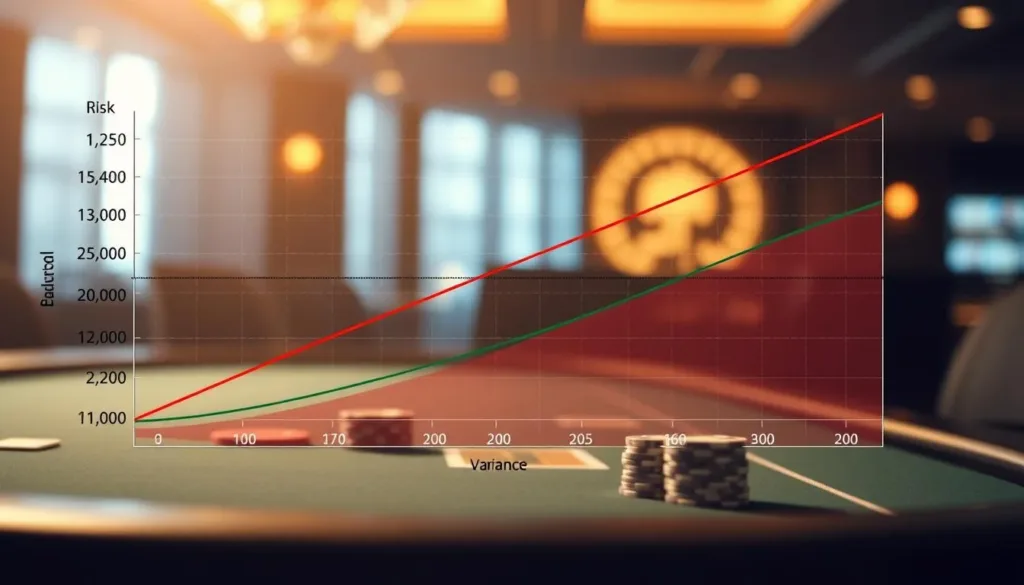
This noise creates downswings—long periods of loss. Without planning, a downswing can wipe out your stake. This leads to a key concept: risk of ruin.
In simple terms, your risk of ruin is the chance of losing all your money. It’s not about skill or edge, but survival. Managing this risk is the most practical use of EV math.
What does variance mean for you?
- It separates short-term luck from long-term results.
- It requires a bankroll large enough to absorb losses without going bust.
- It makes bet size your most important lever for control.
Let’s do a “simple sim” thought exercise. Imagine a 5% edge on a bet and a $1,000 bankroll. Your edge is positive, but your bet size determines your survival odds.
| Bet Size | Edge (EV) | Estimated Risk of Ruin |
|---|---|---|
| $10 (1% of bankroll) | +5% | Very Low ( |
| $50 (5% of bankroll) | +5% | Moderate (~10%) |
| $200 (20% of bankroll) | +5% | Very High (> 50%) |
The table shows a stark truth. The same positive edge leads to wildly different survival chances. Betting too large turns a mathematical advantage into a likely path to zero. This is the core of bankroll management.
Your goal is to choose a bet size that keeps your personal risk of ruin low. For most, that means betting a tiny fraction of your total stake. This ensures you stay in the game long enough for the EV to work in your favor.
Grasping this concept of natural swings is key, whether at the blackjack table or demystifying poker variance. It transforms you from a hopeful gambler into a resilient strategist. You stop chasing short-term wins and start engineering long-term survival.
Kelly Criterion (Beginner-Safe): Fractional Kelly for Volatile Games
The Kelly Criterion is a math formula to grow your bankroll over time. It’s more than just setting loss limits. It helps you decide how much to bet to grow your money while keeping risk low.
This method needs two main things. First, your edge, or the chance you’ll win more than you bet. Second, the variance, or how much the game’s outcome can change. The idea is simple: bet more when you have a big edge and less when the game is unpredictable.
A “Full Kelly” bet is the biggest amount you can bet based on the math. While it could grow your money fast, it’s very risky. It’s not good for beginners because it can lead to big losses.
The fractional Kelly approach is safer for beginners. It’s like betting half or a quarter of what the Full Kelly formula suggests.
Using a Kelly fraction has many benefits:
- It lowers the risk of losing all your money.
- It makes your bankroll less volatile, making downturns easier to handle.
- It gives you a safety net if you’ve guessed your edge wrong.
- You can get a big part of the best growth rate.
This method is key for games that are very unpredictable. Think of online slots, sports betting, or high-risk poker tournaments. The fractional Kelly strategy makes a risky idea into a solid way to manage your money.
| Strategy | Risk of Ruin | Growth Rate | Volatility | Best For |
|---|---|---|---|---|
| Full Kelly | Very High | Maximum Theoretical | Extremely High | Experts with perfect edge estimation |
| Half Kelly | Low | High (~75% of full) | Moderate | Most serious players |
| Quarter Kelly | Very Low | Good (~50% of full) | Low | Beginners & highly volatile games |
Here’s a simple rule. If you figure out a bet size based on your edge, cut it in half. This “Half-Kelly” rule is a great starting point. It adds a safety margin that real-world uncertainty needs.
Think of the fractional Kelly as a way of life. It’s about betting based on your proven advantage and the game’s risk. By betting conservatively, you protect your money. This lets you keep playing and growing your money over time.
Building a personal EV log: tracking decisions and learning
Understanding expected value is one thing. Applying it consistently is another. A personal EV log turns theory into a practical habit.
Start a simple journal or spreadsheet. Record each significant betting decision. Note the estimated EV at the time and the actual outcome. This practice is the core of tracking your bets. It provides raw data to analyze your EV performance.
Reviewing these entries offers powerful feedback. You see where your probability estimates were accurate or off. Patterns in your expected value gambling decisions become clear. You can identify emotional biases that lead to -EV choices. This process solidifies the discipline of seeking positive expected value.
Your log becomes a personal learning tool. It transforms abstract math into concrete experience. This aligns with a professional mindset of continuous improvement. Mastering expected value gambling requires this deliberate practice. Begin your log today to build smarter, more profitable habits.