The game of roulette is all about math, not just luck. The casino’s glamour can hide the key factor: the number of green zeros.
There are two main versions of roulette. European roulette has a wheel with 37 pockets, one single zero. American roulette has 38 pockets, with a second, double-zero pocket.
This extra pocket changes the casino’s edge a lot. The single-zero game has a 2.7% house edge. But the double-zero version has a much higher 5.26% edge.
Knowing this basic math is your first step to better play. It helps you understand the real cost of each bet before you place it.
Wheel layouts and the extra 00 problem
Casinos can gain an edge without changing payouts. They just need to add one extra pocket. This is the flaw of the American double-zero roulette wheel. The green “00” isn’t just for show. It disrupts the game’s balance.
The main issue is the mismatch between payout vs probability. Payouts for winning bets are the same on both wheels. But, the true odds of winning get worse on the American layout. The extra pocket gives the ball more places to lose.
Let’s look at the impact. Adding the 00 pocket changes the total outcomes from 37 to 38.
- On a European (single-zero) wheel, the probability for an even-money bet like Red is 18/37, or 48.65%.
- On an American (double-zero) wheel, that same bet has a probability of 18/38, which drops to 47.37%.
This change affects every single bet on the layout. The house’s advantage grows because payouts no longer match true odds. One source says this change nearly doubles the house advantage.
The table below shows the difference for common bets. The payout stays the same, but winning chances shrink on the double-zero wheel.
| Bet Type | European Wheel (Single-Zero) Probability | American Wheel (Double-Zero) Probability | Standard Payout |
|---|---|---|---|
| Straight Up (Single Number) | 2.70% (1 in 37) | 2.63% (1 in 38) | 35 to 1 |
| Red / Black | 48.65% | 47.37% | 1 to 1 |
| Dozen Bet (1-12, etc.) | 32.43% | 31.58% | 2 to 1 |
| Street Bet (Three Numbers) | 8.11% | 7.89% | 11 to 1 |
This difference is the “00 problem” in action. The casino’s edge grows by reducing your chance to win. For strategic players, choosing the right table is key.
Knowing this payout vs probability mismatch is why smart players prefer single-zero tables. The double-zero wheel shows the hidden costs. By choosing European, you improve the math of every bet.
Probability and Payouts for Each Bet (Straight, Split, Street, Corner, Dozen, Even-Money)
Every chip you place on the layout is a deal with the house. To bet wisely, you need to know the odds of winning and the payout. This turns random bets into smart choices.
Roulette bets fall into two main groups: inside bets and outside bets. This key difference changes how you play the game.
Inside bets are on the numbered grid in the center. They offer big payouts but are less likely to win. These bets are high-risk, high-reward.
Outside bets are on the areas around the numbers. They pay less but win more often. These bets are safer for players.
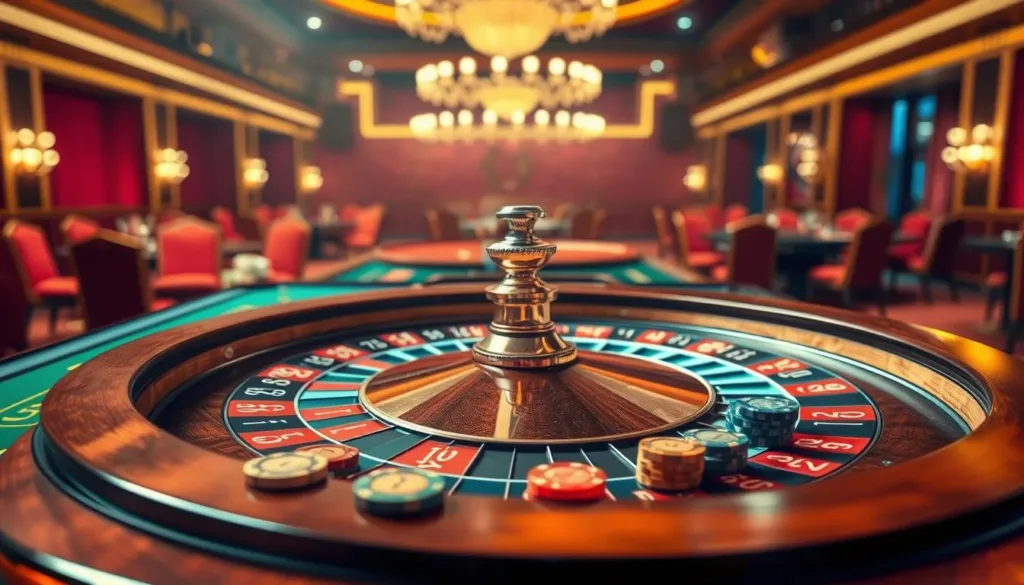
Let’s look at the specific bets in each category. The table below shows details for a standard American double-zero wheel, common in the U.S.
| Bet Type | Payout | Probability (Win %) | House Edge |
|---|---|---|---|
| Straight (Single Number) | 35 to 1 | 2.63% (1/38) | 5.26% |
| Split (Two Numbers) | 17 to 1 | 5.26% (2/38) | 5.26% |
| Street (Three Numbers) | 11 to 1 | 7.89% (3/38) | 5.26% |
| Corner (Four Numbers) | 8 to 1 | 10.53% (4/38) | 5.26% |
| Dozen/Column (Twelve Numbers) | 2 to 1 | 31.58% (12/38) | 5.26% |
| Even-Money (Red/Black, etc.) | 1 to 1 | 47.37% (18/38) | 5.26% |
The table shows a key pattern. Payouts go down as the chance of winning goes up. But the house edge stays the same for all bets on a double-zero wheel. This is a key idea in roulette math.
Inside Bets: The High-Stakes Zone
A straight bet targets one number. You have a 1 in 38 chance to win 35 times your stake. It’s a big risk for a big reward.
A split bet covers two adjacent numbers. Your chance of winning doubles, but the payout is halved to 17 to 1. Place your chip on the line between two numbers.
A street bet covers a row of three numbers. The payout is 11 to 1. Place your bet on the outer edge of the row.
A corner bet (or square) covers four numbers in a block. You have a 10.53% chance to win an 8 to 1 payout. Place your chip at the intersection of the four numbers.
Outside Bets: The Frequent Wins
Dozen and column bets each cover 12 numbers. You can bet on 1-12, 13-24, 25-36, or on one of the three vertical columns. The payout is 2 to 1. You have a chance of winning just under one-third.
Even-money bets are the most popular outside bets. These include red or black, odd or even, and high (19-36) or low (1-18). They pay 1 to 1. You have almost a coin-flip chance, but the 0 and 00 give the house its edge.
For more details on these figures, check out this roulette odds and payouts table.
The choice between inside vs outside bets shapes your game. Do you want the thrill of a big win or more frequent, smaller wins? Your risk tolerance should guide you. A detailed overview of roulette bets can help with strategy.
Remember, the payout always reflects the true odds minus the house edge. Knowing this helps you place chips with purpose.
Effective house edge by rule set and why single-zero matters
The casino’s advantage, known as the house edge, is key to European roulette and American roulette. It shows your average loss over many spins. This edge is what makes casinos profitable.
Think of it as the cost of fun. The edge is hidden in the payouts. For example, betting on one number pays 35 to 1. But the true odds are longer. This difference is where the casino makes its money.
The type of wheel affects this edge. A single-zero wheel has 37 pockets. A double-zero wheel has 38 pockets. That extra pocket makes a big difference.
| Roulette Variant | Wheel Layout | House Edge Calculation | Effective House Edge |
|---|---|---|---|
| European Roulette | Single Zero (37 pockets) | 1/37 | 2.70% |
| American Roulette | Double Zero (38 pockets) | 1/19 (2/38) | 5.26% |
| Atlantic City Rule* | Double Zero (38 pockets) | Special even-money rule | 2.63% (on even-money bets only) |
In European roulette, the edge on a straight-up bet is 2.70%. In American roulette, it’s 5.26%. That extra pocket nearly doubles the house’s edge.
Choosing a European roulette game is better for players. It cuts the casino’s edge nearly in half. For every $100 wagered, you lose about $2.70 on a single-zero table. On a double-zero table, it’s $5.26.
Knowing the effective house edge is key for managing your bankroll. A lower edge means your money lasts longer. This gives you more entertainment value per dollar. The rule set is a big financial decision you make.
Special rules can change this edge. In some American roulette tables in Atlantic City, there’s a “surrendered” rule on even-money bets. This rule returns half your bet or gives you another chance if the ball lands on zero or double-zero. This lowers the house edge on those bets to 2.63%, making it closer to the single-zero standard.
The house edge is the silent partner in every game. Choosing a single-zero wheel is the smartest decision for a roulette player. It reduces the casino’s profit margin and lets you play longer.
Special rules: en prison/la partage impact on even-money bets
On some roulette wheels, the green zero isn’t always a loss for even-money bets. Two special rules from French casinos can help. Knowing about en prison and la partage is key for players.
These rules only apply to outside even-money wagers. This includes bets on red/black, odd/even, and high/low numbers. When the ball lands in zero, these rules make the outcome better.

The la partage rule is simple. If you bet on even-money and zero hits, you get half your bet back. The other half goes to the casino.
This rule cuts the house edge in half. On a European single-zero wheel, the edge on even-money bets is 2.70%. With la partage, it drops to about 1.35%. It’s a big win for players.
Understanding En Prison (In Prison)
The en prison rule offers a different kind of protection. When zero hits, your even-money bet isn’t lost. Instead, it’s “imprisoned” for the next spin.
Your original bet stays on the layout. The next spin decides its fate. If it wins, your bet is returned without profit. If it loses, the casino takes it. If zero hits again, the bet can stay imprisoned.
This rule gives you a second chance. The expected loss from en prison is the same as losing half your bet immediately. So, it also reduces the house edge to 1.35% like la partage on a single-zero wheel.
Key Comparison at a Glance
- La Partage: On zero, you instantly get half your bet back. Simple and immediate.
- En Prison: On zero, your bet is held for a re-spin to potentially recover it. Adds an element of suspense.
Both rules lower the casino’s advantage on your safest bets. You won’t find these rules on standard American double-zero tables. They are hallmarks of European, mainly French, roulette games.
Your takeaway is clear. Look for tables with en prison or la partage. Choosing the right table is one of the smartest, easiest ways to improve your odds.
Betting myths vs risk management: why systems don’t change EV
To understand why betting systems fail, you need to know about Expected Value. It’s the core of casino games. The dream of a “guaranteed” roulette strategy misunderstands the payout vs probability relationship. Every bet on the layout has a fixed mathematical expectation.
Expected Value (EV) is the average win or loss per bet over many spins. It’s based on the game’s probabilities and payouts. The house edge is the casino’s positive EV, shown as a percentage. No sequence of bets can change this disadvantage.
Progressive systems like the Martingale or Fibonacci are popular. They adjust bet sizes after losses, trying to recover previous deficits. These systems manage your session variance, not the odds. A long losing streak will hit your bankroll limit or the table maximum.
Experts agree. The Encyclopedia Britannica and thinkers like Albert Einstein say beating a game with a house advantage is futile. As one source states clearly: “No roulette strategy can overcome the house edge.” Strategies manage risk; they are not for guaranteed profits.
This is the key difference. Disciplined bankroll management is wise. It involves setting loss limits and sticking to a budget to enjoy the game longer. Chasing a “winning system” is a costly mistake. It misuses money management to try to negate negative EV, which is impossible.
The table below shows the promises of common betting systems versus their true math, highlighting the gap between payout vs probability.
| Betting System | Core Promise | Mathematical Reality | Impact on EV |
|---|---|---|---|
| Martingale | Double bets after a loss to eventually recoup all losses with one win. | Requires an infinite bankroll and no table max. Long streaks cause catastrophic losses. | Zero. Does not change the house edge or the expected loss per spin. |
| Fibonacci | Follow a number sequence to manage bet progression more gently. | Slows losses but requires many consecutive wins to show a small profit. Same fundamental flaw. | Zero. Alters bet sizes, not the odds of any single spin. |
| D’Alembert | Increase/decrease bets by one unit based on win/loss for “balance.” | Assumes outcomes will even out in the short term, which is a fallacy (gambler’s fallacy). | Zero. No system can influence independent spin outcomes. |
The smart shift is in mindset. Let go of the search for a magic bullet. Instead, implement sound financial discipline. Use a flat-betting approach with a strict session budget. This manages variance, controls emotions, and turns roulette into a form of entertainment with known, limited risk. Your focus should be on the experience, not on defeating the immutable math of payout vs probability.
Table selection checklist; session variance expectations
Understanding roulette probabilities is key. Start with a table selection checklist. Always choose European roulette wheels. The single-zero layout is essential for better odds.
Check the rules before playing. Places like Las Vegas high-limit rooms have favorable tables. Look for special rules like ‘La Partage’ on even-money bets. This rule cuts the house edge on your bets.
Your bet choice is a strategic move. The debate between outside vs inside bets affects your session risk. Outside bets like red/black or odds/evens have a nearly 50/50 win chance. They offer more frequent, smaller wins.
Inside bets target specific numbers for bigger payouts but have high variance. For longer play, outside bets are safer.
Session variance is a mathematical fact. Short-term results can wildly swing. You might win big in thirty minutes or lose quickly. This is normal.
Manage it by setting win and loss limits before playing. Define success beyond just winning. Aim for a specific entertainment time or a modest profit. This mindset separates smart players from those chasing myths. Your edge comes from strategy, not luck.