I used to walk into casinos with a plan. I combined a precise mathematical chart with card counting. This way, I made over €10,000 a month. The casinos noticed, and I was eventually shown the door.
That experience taught me one undeniable truth: mastering the basic strategy is the non-negotiable first step to consistent success.
So, what is this powerful framework? It’s a set of decisions, based purely on statistics. It tells you the optimal move for every possible hand against the dealer’s up-card. This isn’t guesswork; it’s a calculated method to minimize the casino’s inherent advantage.
The advantage, called the house edge, exists because you must act on your hand before the dealer. If you bust, you lose instantly. Following the basic strategy chart slashes this edge to its bare minimum—often as low as 0.5% in common games.
This means for every $100 you wager, the expected cost of your entertainment is just about 50 cents when you play perfectly. Stray from the chart, and that cost skyrockets. The principles hold true whether you’re at a live table or playing online, as long as the game rules are the same.
How Rules Shape the Edge
Blackjack rules like ‘dealer stands on soft 17’ or ‘surrender is allowed’ are key. They change the odds in your favor. Think of the rule sheet as a control panel for the house edge. Every variation either tightens the casino’s grip or gives you a little more breathing room.
Your first move at any table should be to scan these rules. This knowledge is more immediately powerful than any complex counting system. It lets you choose games where the math is less hostile from the start.
Let’s break down the major players. The rule dealer stands soft 17 (S17) is a player favorite. It means the dealer must stop drawing when their hand totals 17, including an ace counted as 11. The alternative, dealer hits soft 17 (H17), gives the house a bigger chance to improve to a stronger hand. The data is clear: in a common six-deck game, S17 gives the house a 0.4% edge. H17 pushes that edge to 0.62%.
Next, consider surrender. This option lets you fold a terrible hand and recover half your bet. Late surrender, offered after the dealer checks for blackjack, is a powerful tool. It acts as an emergency exit, cutting your losses on stiff hands against a strong dealer upcard. Finding a table with this rule is a significant win.
Now, for the doubling rules. “Double After Split” (DAS) is a big one. It allows you to double your bet on a new hand created after splitting a pair. This increases your profit on good situations. “Double Any Two” (DA2) is even better, letting you double on any initial two cards. More restrictive rules limit your ability to capitalize on strong positions.
Other key terms include “Re-Split Aces” (RSA). This lets you split a pair of aces and then split again if you draw another ace. It turns a tough starting hand into multiple chances for a lucrative 21. Also, pay close attention to the blackjack payout. The standard 3:2 payout is critical. The increasingly common 6:5 payout slashes your winnings and inflates the house edge by over 2%.
Even the number of decks matters. Fewer decks are better for the player. A single-deck game with good rules offers the lowest house edge. European “no hole card” style, where the dealer doesn’t take their second card until players finish, also changes the strategy, often to your detriment.
The table below summarizes how these common rules impact your bottom line. Use it as a cheat sheet for table selection.
| Rule | Description | Effect on House Edge | Player Advice |
|---|---|---|---|
| Dealer Stands on Soft 17 (S17) | Dealer must stop on a soft 17 (Ace-6). | Lowers edge by ~0.2% vs. H17. | Always prefer S17 tables. |
| Late Surrender | Can forfeit hand for half bet back. | Lowers edge by ~0.08% to 0.1%. | A valuable strategic escape hatch. |
| Double After Split (DAS) | Can double down on split hands. | Lowers edge by ~0.14%. | Seek out games with DAS. |
| 3:2 Blackjack Payout | Blackjack pays 3-to-2 odds. | Standard low edge (~0.5%). | Avoid 6:5 tables at all costs. |
| Fewer Decks | Single or double deck vs. 6-8 decks. | Can lower edge by 0.2% or more. | Fewer decks are generally better. |
Armed with this knowledge, you can walk onto any casino floor and quickly spot the good games. Look for the S17, DAS, and surrender signs. This rule-aware approach is the foundation of playing smart. It directly complements a solid basic strategy, helping you play smarter and lose less by avoiding fundamentally poor tables.
Remember, the house builds its edge brick by brick with these rules. Your job is to find the tables where that construction is shakiest. Choosing the right game is the first, and one of the easiest, strategic decisions you can make.
Basic Strategy Fundamentals: The Math Behind Every Decision
Learning simple rules can cut the house edge from 8% to under 1%. This is thanks to a basic strategy chart. It’s not just a guide; it’s a mathematically proven plan for every blackjack decision.
Basic strategy is like a roadmap based on probability trees. Statisticians have simulated millions of hands. They’ve figured out the best play for every situation.
Let’s look at three common hands to understand the logic. Learning these examples is the first step to mastering the chart.
Hand 1: You have 16, Dealer shows a 10. You might want to stand, hoping the dealer busts. But basic strategy says hit. This is because standing on 16 loses about 77% of the time against a dealer 10. Taking a card gives you a chance to improve, even if you might bust.
Hand 2: You have Ace-4 (a “soft” 15), Dealer shows a 4. This is a great time to double down. Your hand is flexible, and the dealer’s weak up card is a high bust risk. Doubling down maximizes your bet when you have an advantage.
Hand 3: You have a pair of 4s, Dealer shows a 5. Never hit this as a total of 8. The best move is to split. Splitting turns one weak hand into two strong starting hands against the dealer’s vulnerable 5.
The table below shows these and other key plays. It’s a quick guide to see how probability guides the best move.
| Your Hand | Dealer’s Up Card | Correct Basic Strategy Play | Key Probability Insight |
|---|---|---|---|
| Hard 16 (e.g., 10-6) | 7, 8, 9, 10, Ace | Hit | Standing is a losing proposition over 70% of the time; hitting offers a chance to improve. |
| Soft A,4 (Soft 15) | 4, 5, 6 | Double Down | Dealer is in a weak position; doubling capitalizes on your hand’s flexibility and higher expected value. |
| Pair of 4s | 5, 6 | Split | Creates two advantageous starting hands from one poor total, exploiting the dealer’s high bust probability. |
| Hard 12 | 2, 3 | Hit | While risky, the dealer’s low cards make it less likely they will bust, so you must try to improve. |
| Ace-7 (Soft 18) | 9, 10, Ace | Hit | Against the dealer’s strong cards, your soft 18 is not strong enough; you need to try for a better hand. |
Memorization is key, but it doesn’t have to be hard. Start with the most common hands. Use free online tools and apps for flashcards. A good old-school method is to deal hands to yourself at home, practicing the correct decision for each one.
Remember, a basic strategy chart is your guide. It’s okay to have a printed or digital copy open while you practice. Casinos allow this at the table. The goal is to make these decisions automatic, protecting your bankroll from costly mistakes.
Learning these fundamentals turns blackjack into a game of probability, not luck. This knowledge is your first step toward playing a professional, mathematically sound game.
Common leaks: soft hands, pairs, 16 vs 10, A,7 plays
Winning at blackjack often comes down to fixing a few common mistakes. These small errors can add up, making the house edge bigger by over 1%.
Learning basic strategy is key. But it’s also important to stick to it, even when it’s hard. This section will help you fix the most common and costly mistakes.
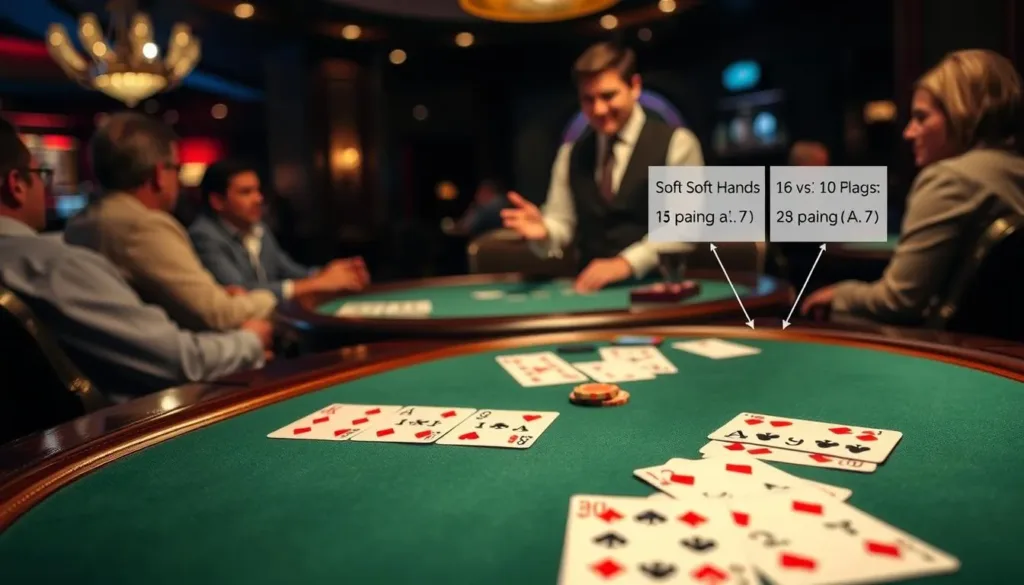
Soft hand mistakes can cost you a lot. A soft hand has an Ace counted as 11. Players often play these hands wrong, fearing they’ll bust.
For example, with a soft 18 (Ace-7) against a dealer’s 6, doubling down is the right move. Many players choose to stand, missing out on a big advantage. Also, with soft 13 through 17 against a dealer’s 4, 5, or 6, doubling down is always the best choice if you can.
Pair splitting errors are also big problems. Always splitting Aces is a key rule. Not doing so gives the dealer a huge edge.
Splitting 8s against a dealer 10 is another tricky but correct play. It turns a likely losing hand (16) into two chances to make a strong hand. Never give up 8,8 unless the table rules say it’s the best move.
The 16 versus a dealer 10 decision is a big challenge. Basic strategy tells you to hit. But advanced players know about composition-dependent strategy.
If your 16 is made of three or more cards, you should stand. A multi-card 16 like 10,4,2 is less likely to bust on a hit than a two-card 16. For most multi-deck games, sticking to the basic “hit” command is safer unless you are counting cards.
These leaks cost a lot. Each mistake might add 0.1% to 0.3% to the house edge. Making several mistakes can make the casino’s advantage up to 3% or more.
The table below outlines key leaks, the correct plays, and their approximate cost.
| Common Mistake | Correct Basic Strategy Play | Approximate Cost to Player Edge |
|---|---|---|
| Standing on 16 vs. Dealer 10 | Hit | +0.4% (house edge) |
| Not Doubling Soft 18 (A,7) vs. Dealer 6 | Double Down | +0.2% |
| Not Splitting Aces | Always Split | +0.6% |
| Not Splitting 8s vs. Dealer 10 | Split | +0.3% |
| Hitting Soft 18 vs. Dealer 2 or 3 | Stand | +0.1% |
The data shows that pair and soft hand decisions carry the heaviest penalties. Knowing these blackjack rules well is essential.
For most players, the best advice is discipline. Don’t let your gut feelings override basic strategy. The math is clear. Memorize these corrections and use them every time.
Don’t overcomplicate things. While there’s advanced strategy, it doesn’t offer much gain in multi-deck games for non-counters. Focus on fixing these common leaks first. This strengthens your game and protects your bankroll from unnecessary losses.
Table selection and etiquette that protect your edge
Choosing the right blackjack table is key to winning. It can boost or hurt your chances against the house. Before you start, pick a table with good rules and a friendly atmosphere.
Table selection is your first defense. A bad table can ruin even the best strategy. Look for games with rules that help you, like surrender and double after split.
But rules are just part of it. Shoe penetration is also important. It’s how deep the dealer goes before shuffling. Deeper penetration helps card counters and changes the game.
The number of players at your table matters too. It affects your bankroll and chances to win. Here’s how many hands you can play per hour:
- Head-to-Head vs. Dealer: ~209 hands/hour
- Full Table (7 players): ~52 hands/hour
At a full table, you face the house edge less often. This is great for casual players. But if you’re serious about winning, you want more hands per hour. Fewer players mean a faster game and more chances to win.
Your behavior at the table is also important. Casinos notice if you play smartly. Playing correctly, even when it’s hard, shows you’re serious. This earns respect and helps you blend in.
Good table manners keep the game friendly. Don’t yell at the dealer or other players. Don’t give advice unless asked. Play calmly with your chips and cards. This lets you focus on the game without distractions.
In short, winning at blackjack is about more than just math. It’s about finding the right table and playing well. By choosing wisely and being respectful, you protect your edge and keep winning.
Counting Overview: The True Count, Legality, and Why Casinos React
Learning to count cards is a big step after mastering basic blackjack rules and strategy. It’s a skill that can change the odds in your favor. This method is based on tracking the deck’s composition.
The basic idea is simple. Counters give +1 for low cards and -1 for high cards. As these cards are played, the count changes. A high count means more high-value cards, which is good for the player.
The true count is key. It’s not just the running count. Players adjust it to reflect the number of decks left. This helps in making better bets and decisions.

Is card counting legal? In the U.S., it’s not illegal. But casinos can refuse service if they think you’re counting. They might ask you to leave or ban you.
Many see card counting as a battle of wits against the house. A story shared about a player’s success led to a casino ban. This shows the risk casinos face with skilled players.
Casinos dislike card counters because they cut into their profits. Casinos use many ways to stop counting. These include surveillance, betting limits, and continuous shuffling machines (CSMs).
CSMs make counting hard by constantly shuffling cards. Online blackjack games also make counting hard because decks are shuffled after each hand. Forums say the real benefit is in using the count to make better bets, not just tracking cards.
First, you must master basic strategy. This frees your mind to focus on counting. Think of it as learning to walk before you run. Counting is based on probability, but it takes practice and discipline. Casinos are always looking to stop it.
Bankroll Tips Specific to Blackjack (Streaky Variance)
Managing your money in blackjack is more than just setting a budget. It’s about protecting yourself from variance. Blackjack is all about streaks. Even with perfect strategy, luck can swing your bankroll wildly.
Your bankroll is your shield. It needs to be big enough to handle the downs. This way, your skill can shine through over time.
How fast you play affects your risk. Live tables deal 60-80 hands per hour. Online games can deal 200+ hands an hour. More hands mean more choices.
For non-counters, more hands mean more losses against the house. For counters, more hands mean faster profits. Either way, speed increases variance.
Your bet size is key. Aim to risk 1-2% of your bankroll per hand. This is critical when using doubling rules. Doubling down can win big, but it also risks more.
Online play needs extra care. The fast pace can quickly use up your bankroll. Set a stop-loss limit for each session. A good rule is 20-30% of your daily bankroll.
Always keep your session bankroll separate from your total. This helps you know when to stop. It stops the dangerous chase after losses.
Here are common bankroll strategies. Pick one based on your risk level and game style.
| Strategy Profile | Bet Per Hand | Risk Level | Session Stop-Loss | Best For |
|---|---|---|---|---|
| Conservative | 0.5% – 1% of total bankroll | Low | 10-15% of session bankroll | Beginners, low-stakes, high-variance games |
| Moderate | 1% – 2% of total bankroll | Medium | 20-25% of session bankroll | Experienced players using basic strategy |
| Aggressive | 2% – 5% of total bankroll | High | 30-50% of session bankroll | High-risk tolerance, favorable doubling rules, or counting |
Doubling rules can make you bet more. But your bankroll must handle the extra risk.
Keep track of your wins, losses, and sessions. This data shows your variance. It helps you adjust your bets wisely.
Never add money if you hit your stop-loss. This discipline is key. Your bankroll guides you, not the other way around.
Blackjack’s streaks are a fact. A good bankroll plan helps you ride them out. It keeps you playing so your skill can win.
Practice plan and free resources
Knowing the theory is the first step. But it’s the consistent application that really cuts the house edge. A structured practice plan turns knowledge into instinct.
Start by drilling hard totals. Use flashcards or a simple deck of cards to quiz yourself on every possible dealer up-card. Master standing on 17 and hitting 12 against a dealer’s 2. Move to soft hands like Ace-7, where the correct play often feels counterintuitive. Practice pair splitting decisions too.
Free digital tools can speed up this process. Online blackjack trainers and simulators give instant feedback. For a dynamic learning tool, try the interactive blackjack strategy calculator. It shows the mathematically correct move for any hand under specific rules.
Keep a basic strategy chart open during online play. Use it to check your decisions in real time. This reinforcement solidifies the patterns in your memory.
Websites like Wizard of Odds offer definitive, free basic strategy charts for every common rule set. Bookmark these resources for quick reference.
Dedicate just fifteen minutes a day to this focused practice. Your confidence at the real table will grow. This turns calculated decisions into automatic plays that protect your bankroll.