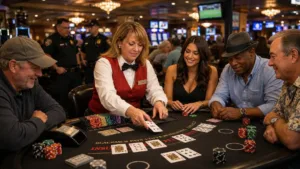
Imagine having a casino survival kit tested by math experts and card sharks. That’s what a blackjack strategy chart offers – no gimmicks, just math. Players often treat these charts like horoscopes, but they actually work.
It’s like knowing the WiFi password at a Vegas high-roller suite. Wizards of Odds data shows perfect use cuts the house edge to 0.5%. Yet, most players ignore it, wondering why their wallet’s empty by midnight.
No system guarantees wins, but not using optimal moves is like fighting with a spoon. Veteran players talk about “hot streaks” and “lucky seats,” but the math doesn’t care. The chart is like Matrix code in green felt – unglamorous but effective when used right.
We’re diving into these probability blueprints with the precision of a blackjack-obsessed MIT grad. You’ll learn why doubling down on 11 is key, when to surrender, and how to turn 48% win probabilities into long-term gains. Let’s turn guesswork into geometry.
What Is a Strategy Chart?
A blackjack strategy chart is like having a smart co-pilot. It doesn’t drive, but it keeps you from making big mistakes. This decision chart helps you make the best moves based on your hand and the dealer’s upcard. It’s not just about knowing the basic rules of blackjack. It’s like becoming a pro at card counting.
Chart Symbols and Sections
At first, these charts might look like ancient texts. But they’re actually easy to understand once you learn the symbols. Let’s look at the main parts:
| Symbol | Meaning | Casino War Story |
|---|---|---|
| H | Hit | “I once saw a tourist hit on 19 because ‘H stood for happiness'” |
| S | Stand | Pro tip: Doesn’t mean “Sprint to the cashier” |
| P | Split | Not an invitation to split your attention with cocktail servers |
| D | Double Down | Yes, even when your gut says “D for disaster” |
The chart is divided into three main areas: hard totals, soft totals, and pairs. Each section is like a story where math decides the plot. Remember, “H17” isn’t a teen movie. It means the dealer hits on soft 17, changing the game like adding pineapple to pizza.
The Math Behind the Chart
Blackjack strategy charts are more than just cheat sheets. They are detailed probability guides that help you beat the house. It’s like playing chess against a supercomputer, but instead, the supercomputer is your brain using statistics. Every decision you make at the table has many possible outcomes. The chart helps you navigate through these possibilities.
Why the Chart Improves Odds
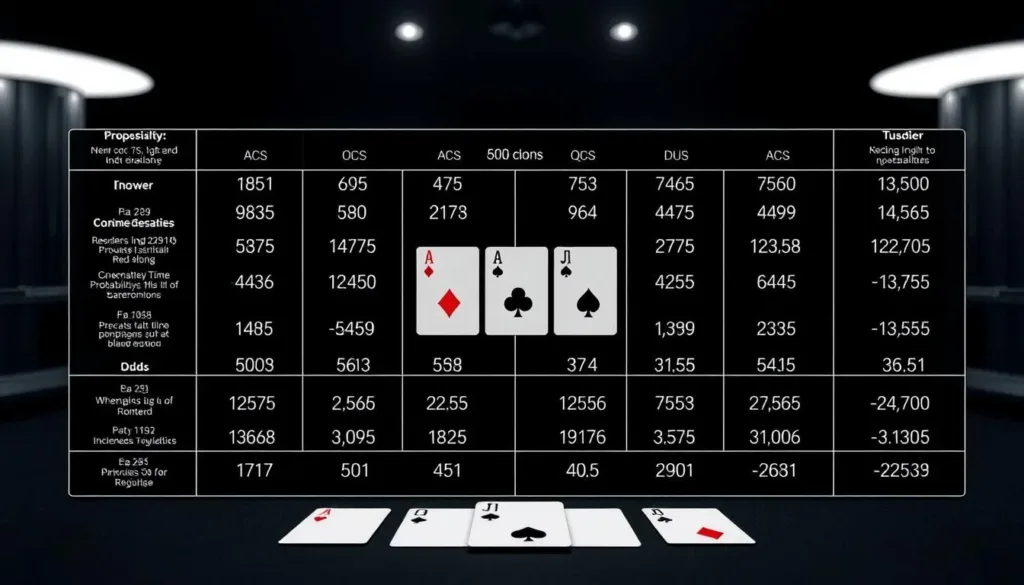
The chart works because it relies on math, not feelings. For example, when you have a 16 and the dealer has a 7, standing seems like giving up. But hitting is like playing a game of chance. The chart tells you to hit, based on expected value (EV) calculations that consider all possible card combinations.
DogHand’s analysis shows hitting 16 against a 7 can lower the house edge by 4.2% compared to standing. This isn’t luck—it’s based on complex math. The chart simplifies these complex scenarios into easy-to-follow instructions, like a poker-faced Einstein whispering in your ear.
| Player Hand | Dealer Upcard | Optimal Move | EV Improvement |
|---|---|---|---|
| Hard 16 | 7 | Hit | +4.2% |
| Soft 18 | 9 | Double | +3.1% |
| Pair of 8s | 10 | Split | +6.7% |
These numbers aren’t magic tricks. They come from Monte Carlo simulations and complex math models. By following the chart, you’re using the wisdom of many experts without needing a PhD.
Think deviating from the chart is a good idea? Would you ignore a weather forecast with a 90% chance of rain? The chart offers similar certainty, turning blackjack into a calculated negotiation with chance. In this high-stakes game, math always wins.
How to Use a Strategy Chart
Learning blackjack strategy charts is like cracking the casino’s code. It makes the house edge nervous. But, unlike video game cheats, these charts don’t guarantee wins. They help turn instinct into strategy. Let’s explore how to use them without looking like you’re solving complex math at the table.
Walkthrough of Common Scenarios
Imagine you have a 16 and the dealer has a 7. Do you hit and risk losing, or stand and hope? Strategy charts are your guide here. They help you make smart choices.
- 16 vs. Dealer 7: Hit in single-deck games, surrender if allowed (most casinos don’t like surrenderers)
- 12 vs. Dealer 3: Stand like you’re trying to be part of Mount Rushmore
- Soft 18 vs. Dealer 9: Double down quickly, like a politician changing their mind
Hard Totals: The Stone-Cold Realists
Hard totals are all about facts, no feelings. For example, a classic 4-deck strategy says hit hard 16 against a dealer 10. This increases your winning chance from 23% to 29%. Math doesn’t care about your feelings.
Soft Totals: Schrödinger’s Blackjack
An Ace-7 hand is like quantum superposition—it’s both 8 and 18 until you decide. The chart advises to double down against dealer 5 or 6, and hit against 9-10-Ace. It’s like having Heisenberg on your side, without the danger.
Pairs: The Sophie’s Choice of Cards
Splitting pairs is like being King Solomon. Do you split 8s like a logical ruler (always) or hold onto 10s like Gollum (never)? Here’s the truth:
- Always split: Aces and 8s—they’re the Romeo and Juliet of pair splits
- Never split: 10s, 5s, and face cards—this isn’t a yard sale
- Sometimes split: 2s, 3s, and 7s—depending on the dealer’s upcard
Mistakes People Make with Charts
Imagine a player looking at their 16 against a dealer’s 7. They mutter “the chart says hit” as they go bust. This is what happens when players follow basic strategy too closely, ignoring the game’s real dynamics. Let’s look at three big blackjack mistakes to avoid that turn strategy into a joke.
The Art of Strategic Rebellion
Blackjack is not just about following rules. Sometimes, you need to change the game. Here are some common mistakes:
- Robot Syndrome: Blindly splitting 10s because “the chart says so” (actual casino surveillance footage exists)
- Dealer Tell Neglect: Ignoring visible hole cards in single-deck games
- EV Myopia: Chasing 0.03% edge increases while tipping away 2% in cocktails
DogHand’s analysis shows some surprising facts. Defensive splitting (like 2s vs dealer 8) costs 0.2% edge to avoid big losses. Sometimes, playing not to lose is better than playing to win.
Our heat maps reveal the cost of deviating from strategy. That “gut feeling” double down on soft 18? You just lost 8.6% EV to the house. But when the count is +12 and the dealer’s sweating? That’s your chance to go full Bond and change the game.
Remember the Vegas pro who doubled on hard 20 “for the chart”? His ex-wife doesn’t. It’s all about balance. Use basic strategy as your base, not your whole identity. Your wallet (and blackjack friends) will appreciate it.
Creating Good Habits with the Chart
Learning blackjack strategy charts is like mastering “Stairway to Heaven” on guitar. You’ll start with awkward motions but soon become precise. The key is consistent, intentional practice that makes decisions feel automatic. Let’s explore how to build lasting habits.
Training Tools & Online Resources
Modern chart mastery uses apps, not flashcards. Apps like Blackjack Apprenticeship’s Drill Machine and CVCX Online make learning fun. The Blackjack 101 app even grades your decisions quickly.
Here are three must-have tools:
- Bankroll management calculators to keep you from overspending
- Live dealer simulators for practicing live dealer blackjack strategies
- Community forums for discussing strategy
Pro tip: Practice blackjack bankroll management alongside chart drills. I used a “mistake tax” system to improve my strategy. After two weeks, I was protecting my virtual chips like Scrooge McDuck.
Remember, charts are guides, not rules. The real skill is knowing the right play before you even think about it. That’s how you win big at live dealer tables. And maybe even afford that Robert De Niro Casino cosplay.
Chart Customization for Rule Variants
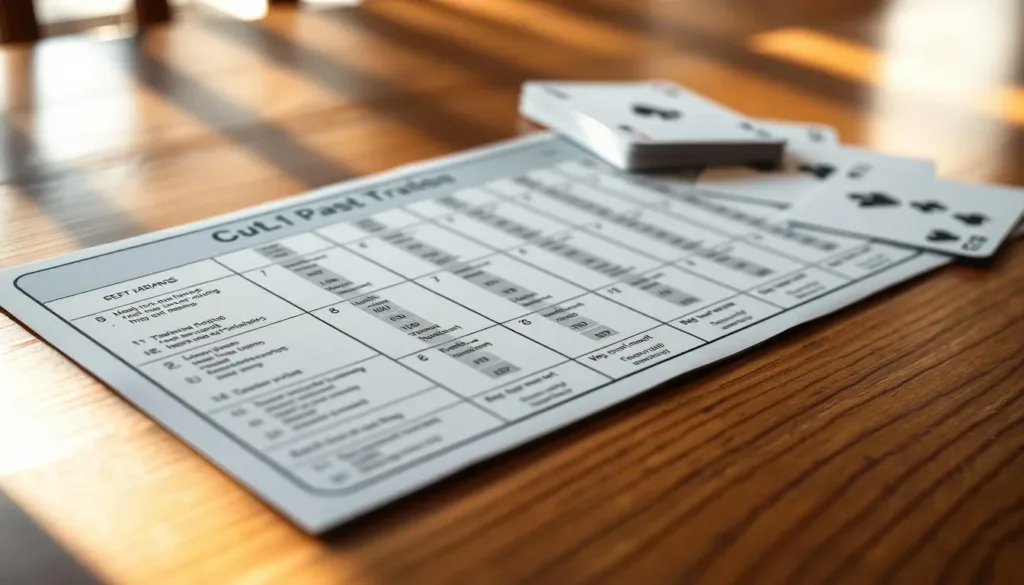
Ever tried charging a MacBook with a Windows laptop adapter? That’s what happens when you use a generic blackjack chart for every game. Casinos change rules like politicians do on campaign promises. Your strategy must change quickly, like a TikTok trend.
The 1970s Vegas revolution brought disco and big changes to blackjack. Casinos moved from single-deck to shoe games, changing strategy math a lot. Today, players face three main variables:
- Deck Count: Single deck vs. 6-deck shoes change doubling decisions a lot
- Dealer Rules: Hitting soft 17? It’s like “choose your own adventure” books
- Payouts: 6:5 vs 3:2 blackjack payouts are like filet mignon vs gas station sushi
Here’s where real strategy comes in. That “perfect” chart your uncle swears by? It’s probably outdated, like his Members Only jacket. Modern players need customized approaches.
| Rule Variant | Strategy Adjustment | Historical Context |
|---|---|---|
| Single Deck | Double down on 11 vs dealer 10 | Pre-1980s Vegas standard |
| 6-Deck Shoe | Stand on 16 vs dealer 7 | Post-2000 tournament norm |
| European No-Hole | Avoid late surrender plays | 1980s Atlantic City innovation |
The history of blackjack shows why customization matters. New Jersey legalized surrender in 1978, creating strategy splits. Modern charts handle these nuances better than GPS handles traffic.
Pro tip: Treat strategy charts like Spotify playlists. Don’t use a Spanish 21 chart at a double-deck table. The math needs specificity – your bankroll will thank you.
Advanced Charts Explained
Move past the basics and dive into the world of card counting in blackjack. Here, math turns into magic, making pit bosses nervous but keeping you safe. It’s where spreadsheets and sleight of hand meet, turning basic strategy charts into sharp tools.
The Hi-Lo system is like a gateway to advanced play. It assigns values like a stock trader, making blackjack a game of numbers:
| Card | Value | Why It Matters |
|---|---|---|
| 2-6 | +1 | Deck rich in high cards? Bet big |
| 7-9 | 0 | Cruise control numbers |
| 10-A | -1 | Insurance becomes math, not guesswork |
Team play strategies turn blackjack into a Ocean’s Eleven-style heist. Roles include:
- Spotters: Human calculators muttering “+1” like Buddhist mantras
- Big Players: High rollers acting clueless while draining shoe after shoe
- Gorillas: Distraction artists ordering mai tais during critical counts
Casinos use facial recognition software, like Minority Report. Our countermeasures? We rotate teams fast and wear outfits that confuse AI algorithms. Think business casual meets Burning Man.
Mental drills separate pros from posers:
- Count backwards from 100 while someone recites baseball stats
- Track multiple decks in your head during Jeopardy! commercial breaks
- Practice advanced blackjack strategies using a metronome set to 120 BPM
True mastery is not just in calculations. It’s about reading the table like a poker face. The math gives you edges, but intuition tells you when to use them. Just don’t blame us when you start seeing +/- values in your grocery receipts.
Bringing the Chart to the Table (Casinos & Online)
Mastering blackjack etiquette is key to being a pro. Casinos watch players who look at strategy sheets too much. Use clever tricks like laminating your chart as a drink coaster or folding it into a napkin.
Online blackjack needs its own strategies. Evolution Gaming’s AI can spot hesitation. Practice fast decisions in DraftKings’ free-play mode. Look for signs of unfair play, like RNGs that shuffle too predictably.
Forum users say BetMGM’s live tables are tough on chart users. Use two screens: one for your chart, one for the game. And remember, keep your mic off when arguing with your cat.
The right strategy can beat any dealer. Whether it’s Caesars’ serious dealers or FanDuel’s algorithms, trust math over luck. Now, it’s time to practice and make the house nervous.