Many new players feel scared by complex math at the table. They think they need a math degree to win.
This is not true. You don’t need to be a math genius to get better at poker.
Dusty “Leatherass” Schmidt, a pro player, showed us something. He was known for his simple, intuitive style. Yet, he won big.
His story teaches us a key lesson. Knowing a few basic concepts can help you make better choices.
Don’t get lost in too many numbers. Stick to the basics for a stronger game.
Learning about pot odds, implied odds, and hand odds is key. These are the basics of making smart decisions.
This guide will make outs, equity, and pot odds easy to understand. We’ll give you simple lessons you can use right away.
This is your first step to playing with more confidence and winning more.
Counting Outs Correctly (Discounted Outs)
Learning poker starts with a key skill: counting cards that can win your hand. This is called counting outs. It’s the first step in making smart decisions. Think of outs as your hand’s lifelines.
An “out” is any card left in the deck that can make your hand better. For example, if you have four hearts after the flop, any of the nine hearts left can complete your flush. Those nine cards are your outs.
Learning a few common draw types helps you get better fast. Here are some numbers to remember:
- Gutshot Straight Draw: 4 outs (one card to complete the straight).
- Open-Ended Straight Draw: 8 outs (two different cards can complete it).
- Flush Draw: 9 outs.
- Combination Draw (e.g., flush and straight draw): 12-15 outs.
Knowing how many outs you have helps you guess your chance to win. Your chance to win drops a lot from the flop to the turn. A flush draw has about a 35% chance to hit by the river on the flop, but only about a 19% chance on the turn if you missed. This is why accurate counting is so important.
The table below shows key probabilities for common out counts. It’s a vital reference for any player.
| Number of Outs | Odds to Hit (Turn + River) | Odds to Hit (River Only) | Common Hand Example |
|---|---|---|---|
| 4 | ~16.5% / 5.1-to-1 | ~8.7% / 10.5-to-1 | Gutshot Straight Draw |
| 8 | ~31.5% / 2.2-to-1 | ~17.4% / 4.7-to-1 | Open-Ended Straight Draw |
| 9 | ~35% / 1.9-to-1 | ~19.6% / 4.1-to-1 | Flush Draw |
| 15 | ~54.1% / 0.85-to-1 | ~32.6% / 2.1-to-1 | Flush Draw + Straight Draw |
The Advanced Concept: Discounted Outs
Beginners often count all their apparent outs. But advanced players know not all outs are equal. Some cards might improve your hand but also help your opponent. These are not true outs and must be “discounted.”
For example, a flush draw on a board with two connected cards. A heart gives you a flush, but if the board pairs, it could give an opponent a full house. That heart out might be partially discounted.
How do you adjust your counting outs process? You must read the board texture and your opponent’s likely range. Aggressive betting on a scary board often means some of your outs are tainted. If you suspect an opponent has a higher flush draw, your outs are reduced.
Here’s a simple framework for discounting:
- Identify all theoretical outs based on your draw.
- Analyze the board for possible better hands (paired boards, straight possibilities).
- Consider opponent action. Heavy betting or raising suggests strength.
- Subtract the number of outs you believe are no longer safe.
Moving from simple memorization to this nuanced application separates casual players from serious students. Accurate out counting, with proper discounting, turns a vague hope into a precise calculation. It is the essential foundation for all the pot odds and equity math that follows.
Pot odds and break-even call math with quick formulas
Knowing your outs is just the start. The next step is figuring out the pot’s offer. This is called pot odds. Learning this skill turns uncertain decisions into clear choices.
Pot odds compare the cost of calling to the possible win. You look at the bet amount versus the total pot. If it’s fair, you call. If not, you fold.
Calculating pot odds is simple. Just follow these steps every time you face a bet:
- Calculate the final pot size if you call. Add the current pot size to the bet and your call amount.
- Divide your call amount by that final pot size. This gives a decimal ratio.
- Multiply the decimal by 100. This turns the ratio into a percentage you need to break even.
Let’s say the pot is $50. Your opponent bets $25. You need to call $25 to stay in.
Final pot if you call = $50 (pot) + $25 (bet) + $25 (your call) = $100. Your call is $25. $25 / $100 = 0.25. Multiply by 100 = 25%.
You need at least 25% equity to call. If your hand’s chance is more than 25%, it’s a good bet.
This equity percentage is your break-even point. It shows if calling is mathematically right.
Remembering every calculation during a hand is hard. Quick reference tables help a lot. Here’s a table for equity needed to call against common bet sizes.
| Bet Size (Relative to Pot) | Equity Needed to Call | Quick Formula |
|---|---|---|
| Pot Bet (100%) | 33% | Call / (Pot + 2*Bet) |
| 3/4 Pot (75%) | 30% | Approx. 30% rule |
| 1/2 Pot (50%) | 25% | Call / (Pot + 1.5*Bet) |
| 1/3 Pot (33%) | 20% | Call / (Pot + 1.33*Bet) |
These numbers are quick shortcuts. For example, against a half-pot bet, you need about 25% equity. Compare this to your hand’s strength for a fast decision.
The power of pot odds is linking a clear price to your chance of winning. You stop guessing and know exactly when to call.
Practice these formulas away from the table. Use them in hand reviews. Soon, finding break-even points will be second nature. This math protects you from making emotional calls.
Equity vs range: using free calculators for study
Equity isn’t a fixed number. It changes a lot based on the range of hands you put your opponent on. This is a big step from just counting hands.
Your hand’s strength is relative. A pair of Aces has huge equity against random hands. But against a range of stronger Aces and premium pairs, its equity drops. Moving to thinking in ranges is a big step up in strategy.
Building a range means listing all the hands your opponent might have in a given situation. Is the player in the Cutoff position tight or loose? Do they raise with many suited connectors? Your guess defines their range.
This is where a free equity calculator becomes your best study tool. Tools like Equilab and PokerStove do the hard work. You just input your hand, your opponent’s range, and the board. They instantly show your equity percentage.
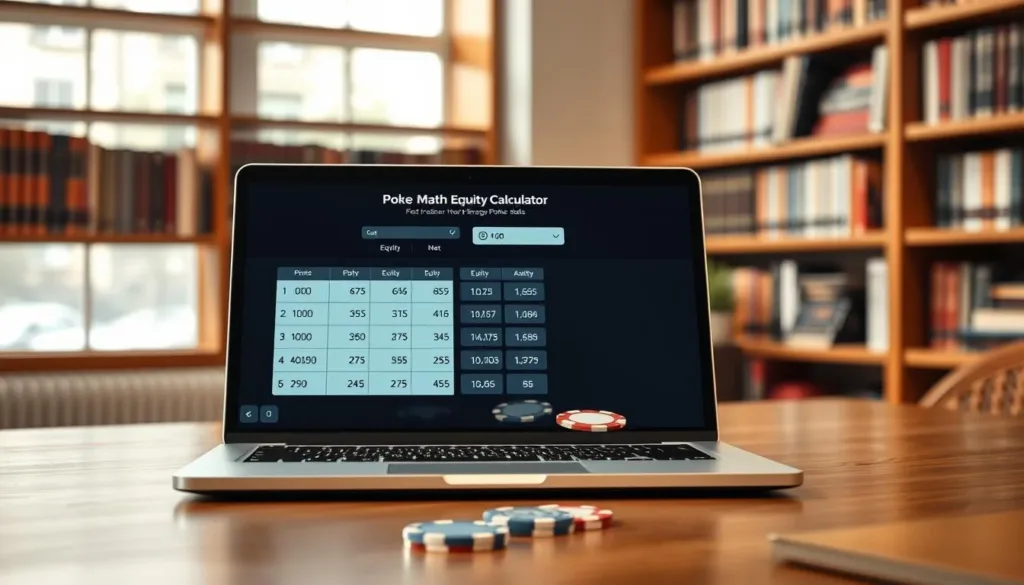
Let’s look at a real example. You have 7♦ 5♦ on the button. The Cutoff raises. You’ve guessed their raising range as the top 15% of hands. Pot odds say you need 25% equity to call profitably.
You enter “7d5d” as your hand. For the opponent’s range, you input the top 15%. The equity calculator might show a result of 28%. Your equity is more than the needed 25%. This math backs up calling preflop.
Using these tools off the table turns guesses into knowledge. You can test different scenarios. What if their range is wider? What if the board is scarier? This study helps you understand hand strength better.
Make range-based analysis a key part of your study sessions. It helps you make clearer, more confident decisions at the table.
Implied Odds and Reverse Implied Odds (When They Matter)
Implied odds and reverse implied odds take your thinking beyond the current street. They ask what your hand could be worth by the river. Unlike pot odds, which focus on the present, these ideas look at the future.
Implied odds are the extra money you might win later if your hand improves. They’re useful when pot odds alone don’t make a call worth it. This is an estimate based on your understanding of the situation.
Your implied odds are higher when these factors are present:
- Opponent Type: A loose, passive player will pay you off more often than a tight player.
- Hand Strength: Drawing to the best possible hand, like the top straight or the nut flush.
- Deceptiveness: Your draw is well-hidden from your opponent.
An obvious flush draw on the flop is different from a hidden gutshot straight draw. The flush draw is scary and visible. If a third flush card comes, your opponent might fold. The gutshot, on the other hand, is hidden. If you hit your straight, your opponent might not see it coming and could pay off a big bet.
The flip side is reverse implied odds. This is the risk that making your hand could lose you a big pot. It’s the “extra money you might lose” on future streets.
Reverse implied odds are a big risk in two situations. First, when your draw is obvious. If you have a flush draw and the flush completes, even a loose opponent might get scared and not pay you. Second, and more critically, when you are drawing to a second-best hand. Making a non-nut flush or a low straight can be expensive if someone else has a better version of the same hand. Understanding the dangers of reverse implied odds is what separates good players from great ones.
Here’s your simple framework. Favor calls with high implied odds against loose players with hidden, nutted draws. Be wary of calls with high reverse implied odds against tight players or when your draw is obvious and non-nut. This forward-thinking approach turns speculative calls into profitable investments and turns possible disasters into disciplined folds.
Bluff math: break-even bluff frequency by bet size
We’re now diving into the math behind when a bluff is a smart bet. Unlike many, winning players don’t bluff on feel alone. They calculate the risk and reward carefully.
This calculation is about your break-even bluff frequency. It asks, “How often does my opponent need to fold for this bluff to win?”
The math is straightforward: Bet Size / (Bet Size + Pot Size). This formula tells you the success rate needed as a decimal or percentage.
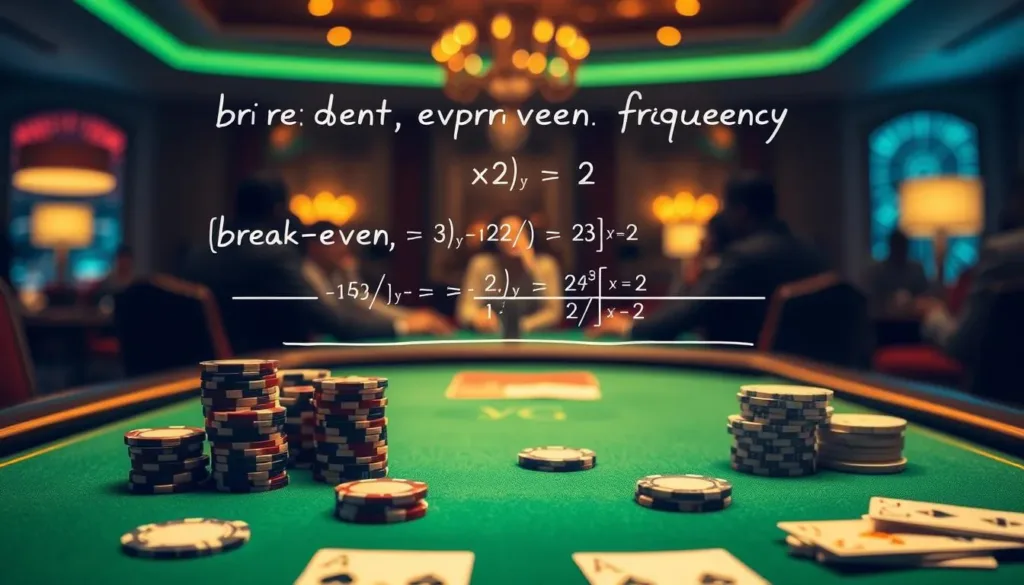
If your opponent folds more than this percentage, your bluff makes money. If they fold less, you lose in the long run. Let’s see how this works with different bet sizes.
The table below shows success rates for common bets. Knowing these helps you make quick decisions at the table.
| Your Bet Size | Required Bluff Success | Practical Meaning |
|---|---|---|
| 1/3 Pot | 25% | Needs to work 1 in 4 times. |
| 1/2 Pot | 33% | Needs to work 1 in 3 times. |
| 3/4 Pot | 43% | Needs to work nearly half the time. |
| Pot-Sized Bet | 50% | Needs to work half the time. |
Notice a trend: smaller bets need a lower fold rate to be profitable. For example, a half-pot bluff only needs to succeed 33% of the time. But a full-pot bet requires a 50% success rate.
This math also has a counterpart for the player facing the bet, called Minimum Defense Frequency (MDF). MDF is the minimum percentage of your hands you should keep to prevent an opponent from bluffing you profitably.
It’s calculated as: Pot Size / (Pot Size + Bet Size). If your opponent bets half-pot, your MDF is 67%. This means you must call or raise with at least 67% of your range to stop them from exploiting you with any two cards.
Understanding both sides of this equation is powerful. It teaches you not just when to bluff, but also when you must call to protect your stack. This turns bluffing from a gamble into a strategic tool based on clear, break-even bluffs math.
Bankroll and table selection for beginners
Learning poker odds and outs is key, but it’s even more important to manage your money well and choose the right games. These are like your poker business plan.
Without them, even the best math can’t save you from losing in the long run.
Managing your bankroll helps you deal with luck’s ups and downs. Luck can change even when you make the right call. A good bankroll helps you stay afloat.
For new players, it’s wise to be cautious. Aim for 20 to 50 full buy-ins for the games you play. For example, if you play $1/$2 No-Limit Hold’em with a $200 buy-in, you should have between $4,000 and $10,000 in your bankroll.
Your strategy should fit the game you play. Here are some simple, effective guidelines.
| Game Type | Conservative Rule | Aggressive Rule (More Risk) | Key Purpose |
|---|---|---|---|
| Cash Games | 50 Buy-ins | 20 Buy-ins | Weather long downswings |
| Multi-Table Tournaments | 100 Buy-ins | 50 Buy-ins | Cover high prize variance |
| Single Table Sit & Gos | 50 Buy-ins | 30 Buy-ins | Manage faster-paced swings |
Choosing the right table is like multiplying your profits. Look for games where your skills will make a big difference. You want to play against recreational players, not pros.
Look for these soft spots in the lobby:
- High Average Pot Size: This means players are calling too much. Your value bets get paid more.
- Many Players Seeing the Flop: A high “Flop %” means players are loose and passive. Your draws have better implied odds.
- Short Stacks: Players with small stacks make math easier. Your decisions are clearer.
Using your poker odds and outs knowledge against these opponents helps you win. It turns your theoretical edge into real money.
A solid bankroll and smart table choice are the foundation. They let you play confidently and focus on making the right mathematical decisions you’ve learned.
Practice drills with answer key
Learning poker math needs practice. This drill helps you understand counting outs and pot odds better.
Drill Scenario: You have 8♠9♠. The flop is 7♣T♥2♠. The pot is $50. Your opponent bets $25. What are your outs? What are the pot odds? Should you call?
Answer Key: First, count your outs. You have an open-ended straight draw. Any Jack or Six completes it. That gives you 8 total outs. The pot is now $75 ($50 + $25). You must call $25. Your pot odds are $75-to-$25, or 3-to-1.
You need about 25% equity to break even. With 8 outs, your chance to hit on the turn is roughly 17%. This is below the required 25%, making it a fold based on pot odds alone. Implied odds could justify a call if you expect to win a much larger pot on later streets.
Working through these calculations turns theory into instinct. Mastering foundational strategy is vital, whether calculating poker odds outs or applying core blackjack principles for better decisions. You can explore fundamental blackjack strategy in this detailed guide.